
Annotate dropdown attestation easily


How to swiftly Annotate dropdown attestation and enhance your workflow
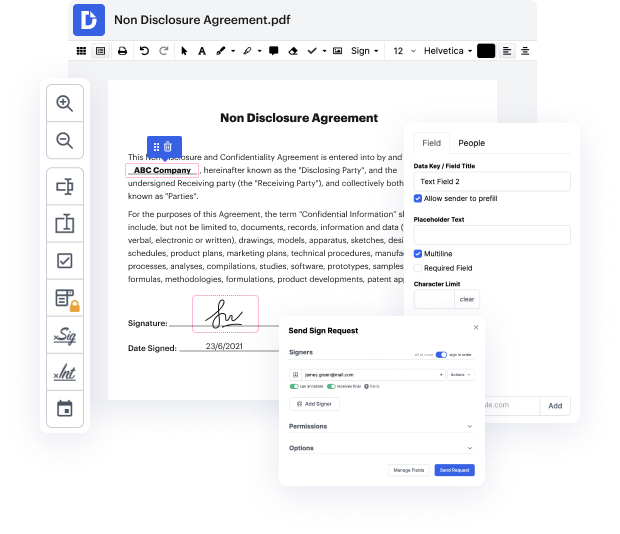
Document editing comes as an element of numerous occupations and jobs, which is why tools for it must be available and unambiguous in terms of their use. A sophisticated online editor can spare you a lot of headaches and save a considerable amount of time if you need to Annotate dropdown attestation.
DocHub is an excellent example of an instrument you can master right away with all the valuable functions accessible. You can start editing instantly after creating your account. The user-friendly interface of the editor will help you to locate and utilize any feature in no time. Notice the difference with the DocHub editor the moment you open it to Annotate dropdown attestation.
Simply follow these steps to start editing your documents:
- Visit the DocHub site and click on Sign up to make an account.
- Provide your current email address and set up a password to complete the signup.
- Once finished with the registration, you will be directed to your dashboard. Select the New Document button to add the file you need to edit.
- Pull and drop the file from your gadget or link it from your cloud storage.
- Open the file in the editor and use its toolbar to Annotate dropdown attestation.
- All the changes in the document will be saved automatically. Upon finishing the editing, just go to your Dashboard or download the file on your gadget.
Being an integral part of workflows, file editing must stay straightforward. Using DocHub, you can quickly find your way around the editor and make the required modifications to your document without a minute wasted.
PDF editing simplified with DocHub






Drive efficiency with the DocHub add-on for Google Workspace
How to annotate dropdown attestation
In this tutorial, the focus is on setting up a model to handle multiple scenarios. Often, models inherited from others only cater to one set of assumptions. By copying and pasting the current scenario, you can easily expand and create additional scenarios. This allows for different alternatives to be considered, with each scenario having an identical structure and layout. By naming these scenarios (such as upside case and downside case), you can effectively analyze different possibilities within the model.

See why our customers choose DocHub


Security and compliance
At DocHub, your data security is our priority. We follow HIPAA, SOC2, GDPR, and other standards, so you can work on your documents with confidence.
Learn more


