


Create your Washington State Garnishment Form from scratch

Start Building Now
Title decoration

Here's how it works

01. Start with a blank Washington State Garnishment Form
Open the blank document in the editor, set the document view, and add extra pages if applicable.
02. Add and configure fillable fields
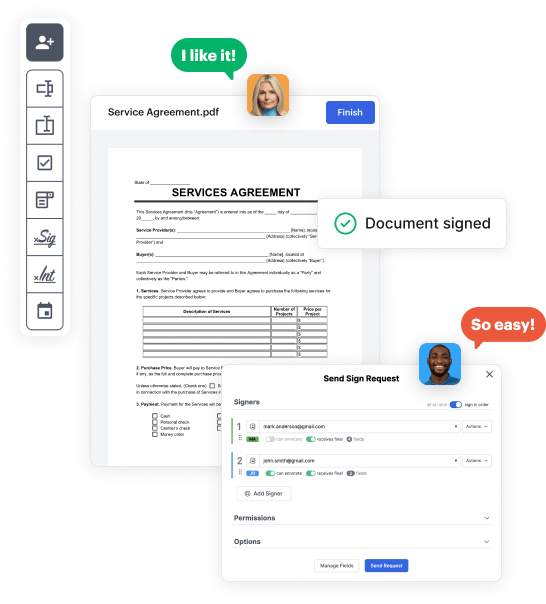
Use the top toolbar to insert fields like text and signature boxes, radio buttons, checkboxes, and more. Assign users to fields.
03. Distribute your form
Share your Washington State Garnishment Form in seconds via email or a link. You can also download it, export it, or print it out.

Build Washington State Garnishment Form from the ground up with these detailed guidelines

Form edit decoration

Step 1: Start off by launching DocHub.

Begin by registering a free DocHub account using any offered sign-up method. If you already have one, simply log in.

Step 2: Register for a 30-day free trial.

Try out the whole collection of DocHub's pro features by signing up for a free 30-day trial of the Pro plan and proceed to build your Washington State Garnishment Form.

Step 3: Create a new empty doc.

In your dashboard, select the New Document button > scroll down and hit Create Blank Document. You will be taken to the editor.

Step 4: Arrange the view of the document.

Use the Page Controls icon marked by the arrow to switch between two page views and layouts for more convenience.

Step 5: Start inserting fields to design the dynamic Washington State Garnishment Form.

Navigate through the top toolbar to add document fields. Add and format text boxes, the signature block (if applicable), insert images, etc.

Step 6: Prepare and customize the added fields.

Organize the fillable areas you added per your chosen layout. Modify each field's size, font, and alignment to ensure the form is easy to use and polished.

Step 7: Finalize and share your form.

Save the ready-to-go copy in DocHub or in platforms like Google Drive or Dropbox, or craft a new Washington State Garnishment Form. Share your form via email or get a public link to engage with more people.


be ready to get more

Build your Washington State Garnishment Form in minutes

Start creating now

Got questions?

We have answers to the most popular questions from our customers. If you can't find an answer to your question, please contact us.
Contact us
When a person owes a debt and is in collections, the creditor may go to court to get a judgment against that person. That judgment can then be used to garnish the persons bank account.
It is possible to stop a wage garnishment order by attacking the underlying court order (such as by filing a motion to vacate the judgment), petitioning the court, or seeking an exemption. However, the fastest way to stop wage garnishment in Washington is to file for bankruptcy.
Consumer debt exemptions are based on either 80% of disposable income or 35 times the state minimum wage which is now (2023) set at $15.74. Federal minimum wage remains unchanged and applies to general non-consumer, non-student loan, non child support, non spousal support type debts.
Under Washington law, creditors can garnish as much as 25% of your weekly disposable earnings, or your weekly disposable earnings minus 35 times the federal minimum wage.
The judgment creditor as the plaintiff or someone in the judgment creditors behalf shall apply for a writ of garnishment by affidavit, stating the following facts: (1) The plaintiff has a judgment wholly or partially unsatisfied in the court from which the writ is sought; (2) the amount alleged to be due under that
be ready to get more

Build your Washington State Garnishment Form in minutes

Start creating now

Related Q&A to Washington State Garnishment Form

Some sources of income are considered protected in account garnishment, including: Social Security, and other government benefits or payments. Funds received for child support or alimony (spousal support) Workers compensation payments.
For instance, if youre behind on credit card payments or owe a doctors bill, those creditors cant garnish your wages unless they sue you and get a judgment. Some creditors, however, like those you owe taxes, federal student loans, child support, or alimony, dont have to file a suit to get a wage garnishment.

Additional resources on building your forms