
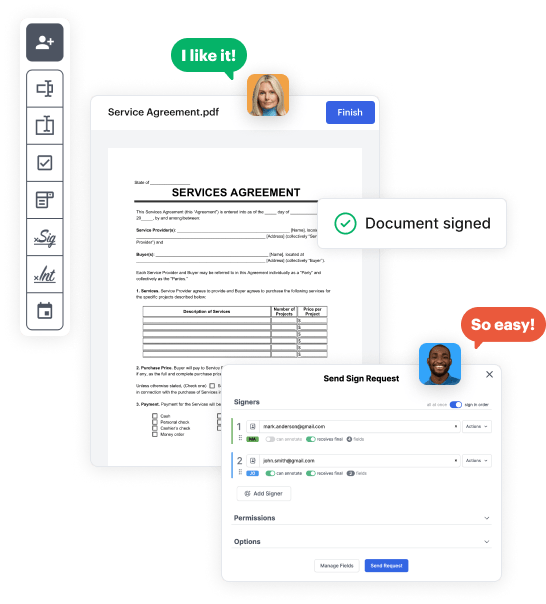
Create your US Site Work Package from scratch

Start Building Now
Title decoration

Here's how it works

01. Start with a blank US Site Work Package
Open the blank document in the editor, set the document view, and add extra pages if applicable.
02. Add and configure fillable fields
Use the top toolbar to insert fields like text and signature boxes, radio buttons, checkboxes, and more. Assign users to fields.
03. Distribute your form
Share your US Site Work Package in seconds via email or a link. You can also download it, export it, or print it out.

Design your US Site Work Package in a matter of minutes

Form edit decoration

Step 1: Access DocHub to build your US Site Work Package.

Begin by logging into your DocHub account. Try out the advanced DocHub functionality at no cost for 30 days.

Step 2: Go to the dashboard.

Once signed in, go to the DocHub dashboard. This is where you'll build your forms and handle your document workflow.

Step 3: Design the US Site Work Package.

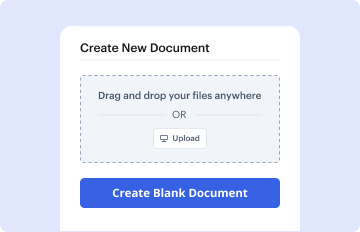
Hit New Document and choose Create Blank Document to be redirected to the form builder.

Step 4: Design the form layout.

Use the DocHub toolset to insert and arrange form fields like text areas, signature boxes, images, and others to your document.

Step 5: Add text and titles.

Add necessary text, such as questions or instructions, using the text tool to lead the users in your document.

Step 6: Customize field settings.

Adjust the properties of each field, such as making them required or arranging them according to the data you expect to collect. Designate recipients if applicable.

Step 7: Review and save.

After you’ve managed to design the US Site Work Package, make a final review of your document. Then, save the form within DocHub, export it to your selected location, or share it via a link or email.


be ready to get more

Build your US Site Work Package in minutes

Start creating now

Got questions?

We have answers to the most popular questions from our customers. If you can't find an answer to your question, please contact us.
Contact us
The third and lowest level shows work packages. Most WBS charts have 3 levels, but you can add more depending on the complexity of your projects. Each of those five project phasesinitiation, planning, execution, control and closeout, also act as control accounts and branch off the main deliverable at the top.
It is very similar to the Product Breakdown Structure (PBS), and created in the same way, however where the PBS looks at the products (or deliverables/outputs), recognised as nouns, the WBS records the activities involved, typically verbs.
An example of a work package is construction. There are different teams, painters, masons, plumbers, and handymen. A project manager leads the teams, and each team is given their leader, specific work, a specific schedule, and how long they should take to complete their jobs.
Work packages are asdocHub units of work that will be performed to create the related deliverable. A work package can be assigned to one particular project team member, one outside contractor, or another team.
The CWBS contains the complete WBS hierarchy for a specific contract scope of work. It is developed by the contractor in ance with the contract statement of work (SOW). It includes the WBS elements for the products which are to be furnished by the contractor.
be ready to get more

Build your US Site Work Package in minutes

Start creating now

Related Q&A to US Site Work Package

What are the types of WBS? Work breakdown structure is generally divided into three distinct types: deliverable-based WBS, phase-based WBS, and responsibility-based WBS.
How to create a work package Identify the final goal of the project. The first step is to have a clearly defined outcome for the entire project. Determine the major tasks of the project. Define subtasks as needed. Create work packages for each task or subtask. Establish activities for each unit of work.
Work packages are the smallest unit of work that a project can be broken down into when creating your Work Breakdown Structure (WBS). Tasks are typically grouped into work packages based on geographical area, engineering discipline, technology, or the time needed to accomplish them.

Additional resources on building your forms


