Increase your productivity with US Legal Wills

Form management consumes to half of your office hours. With DocHub, you can easily reclaim your time and improve your team's efficiency. Get US Legal Wills online library and discover all templates related to your daily workflows.

The best way to use US Legal Wills:

  1. Open US Legal Wills and use Preview to find the appropriate form.
  2. Click on Get Form to begin working on it.
  3. Wait for your form to open in the online editor and begin modifying it.
  4. Add new fillable fields, symbols, and pictures, adjust pages order, and many more.
  5. Complete your file or set it for other contributors.
  6. Download or share the form by link, email attachment, or invite.

Speed up your daily document management with our US Legal Wills. Get your free DocHub profile right now to discover all forms.


Commonly Asked Questions about US Legal Wills

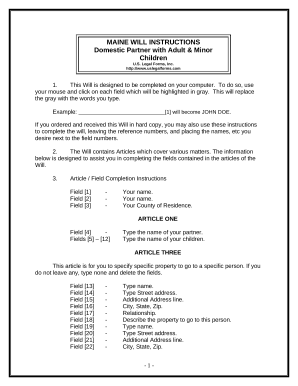
Foreign wills are recognised in the United States. Each state has different requirements for admitting a foreign will for probate. Generally, probate courts will require a copy of the foreign will, a certified translation of the foreign will by a qualified translator and an affidavit from the qualified translator.
State laws usually require that a will is in writing but do not specify that it must be typed. A handwritten will that meets witness requirements is admissible to probate in most states. However, typing a will is preferred because it avoids forcing a judge to interpret the testators handwriting.
Often, but not always, notaries can docHub these copies. The certified copy does not docHub the validity of the primary document, only that of the copy. A probated or certified copy of the will of the executor of a property can usually be obtained from the county courthouse where the will was registered.
In most states, you dont need to docHub your own will for it to be valid and binding. However, you need two disinterested witnesses. Also, state laws and regulations tend to change over time. This is why you should ensure that you have the latest information when drafting your will.
Yes, a DIY will is still a valid will, as long as it meets the legal requirements in your state. For example, if you write your will by hand (known as a holographic will), you should still have two witnesseswho saw you sign the will and dont stand to inherit anything from yousign it.
You do not have to register your own will, but its a very good idea. There is absolutely nothing in the law that requires a will to be registered for it to be valid. You can simply write your will, do what you need to make it legal, and store it in a safe place for your loved ones to read later.
If there is no will, the decedents property goes to their relatives based on intestate succession law. The other partner will retain their separate property only. Property owned by both parties as tenancy by the entirety or joint tenants with the right of survivorship will pass to the surviving partner.