Handle US Legal Deed Documents easily online

Document management can overpower you when you can’t discover all the documents you require. Fortunately, with DocHub's vast form library, you can discover all you need and easily handle it without the need of changing among apps. Get our US Legal Deed Documents and start utilizing them.

The best way to manage our US Legal Deed Documents using these basic steps:

  1. Browse US Legal Deed Documents and select the form you require.
  2. Preview the template and click on Get Form.
  3. Wait for it to open in the online editor.
  4. Change your form: add new information and images, and fillable fields or blackout certain parts if required.
  5. Prepare your form, save adjustments, and prepare it for delivering.
  6. When you are ready, download your form or share it with other contributors.

Try out DocHub and browse our US Legal Deed Documents category with ease. Get your free account right now!


Video Guide on US Legal Deed Documents management

video background

Commonly Asked Questions about US Legal Deed Documents

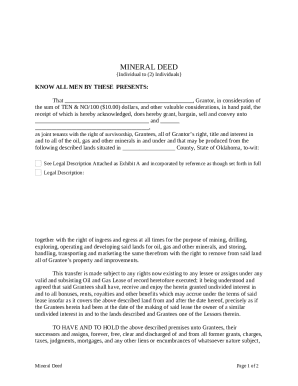
When you own a home, the deed is the physical document that proves ownership. The title is the concept of legal ownership that the deed grants you. You can think of the deed as the document that transfers, or passes on, the title or the right to ownership.
A deed is a signed legal document that transfers ownership of an asset to a new owner. Deeds are most commonly used to transfer ownership of property or vehicles between two parties. The purpose of a deed is to transfer a title, the legal ownership of a property or asset, from one person or company to another.
A warranty deed, which also may be called a general warranty deed, is the type of deed used most frequently when real property is sold. A warranty deed guarantees that the title is free and clear of debts or liens.
A general warranty deed is often considered the most common way to transfer real property. It is used when you are aware and confident that the title to your property is good and marketable. It is most commonly used for residential real estate transactions.
For a deed to be valid, it must contain several essential elements, including the operative words of conveyance, description of the property, signatures, delivery, proper formatting and execution, absence of defects and encumbrances, legal capacity of parties, proper recording, and voluntary execution.