


Create your US Domestic Relations Legal Form from scratch

Start Building Now
Title decoration

Here's how it works

01. Start with a blank US Domestic Relations Legal Form
Open the blank document in the editor, set the document view, and add extra pages if applicable.
02. Add and configure fillable fields
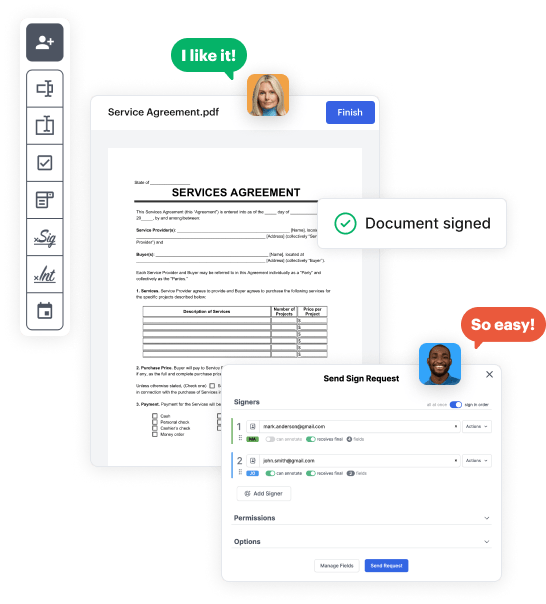
Use the top toolbar to insert fields like text and signature boxes, radio buttons, checkboxes, and more. Assign users to fields.
03. Distribute your form
Share your US Domestic Relations Legal Form in seconds via email or a link. You can also download it, export it, or print it out.

A brief guide on how to create a polished US Domestic Relations Legal Form

Form edit decoration

Step 1: Sign in to DocHub to create your US Domestic Relations Legal Form.

First, log in to your DocHub account. If you don't have one, you can easily register for free.

Step 2: Head to the dashboard.

Once logged in, head to your dashboard. This is your primary hub for all document-centric operations.

Step 3: Initiate new document creation.

In your dashboard, choose New Document in the upper left corner. Select Create Blank Document to create the US Domestic Relations Legal Form from the ground up.

Step 4: Insert template fillable areas.

Place numerous fields like text boxes, photos, signature fields, and other options to your template and assign these fields to specific recipients as needed.

Step 5: Configure your form.

Personalize your document by adding walkthroughs or any other vital tips utilizing the text feature.

Step 6: Double-check and tweak the document.

Attentively go over your created US Domestic Relations Legal Form for any inaccuracies or necessary adjustments. Utilize DocHub's editing features to polish your form.

Step 7: Distribute or export the form.

After completing, save your copy. You may select to retain it within DocHub, export it to various storage solutions, or send it via a link or email.


be ready to get more

Build your US Domestic Relations Legal Form in minutes

Start creating now

Got questions?

We have answers to the most popular questions from our customers. If you can't find an answer to your question, please contact us.
Contact us
Domestic relations is a reference to the field of family law, which governs relations within a family or household. In the past, these relations were limited to those between spouses, parents and children, and legal guardians and wards.
Under the domestic-relations exception to federal jurisdiction, federal courts lack the power to hear certain cases involving family-law questions that fall within the traditional authority of the states. 1 The exception was first articulated in 1858: in Barber v.
US Family law is a branch of the law that deals with issues involving a family, which can include a spouse, a couple, or kids. This covers legal disciplines like adoption, child custody, and divorce.
Custody Petition, (Form 580, Parent or Non-Parent) (Visitation Petition) (Form 585), is simply a sworn request of the Hamilton County Juvenile Court to grant temporary legal custody or parenting rights to the petitioner. Motions are applicable when a modification action is filed on an existing case.
The Domestic Relations Law of 1973 governs various aspects of marriage, divorce, and custody of childrenwhile also providing protections for womens property rights in marriage.
be ready to get more

Build your US Domestic Relations Legal Form in minutes

Start creating now

Related Q&A to US Domestic Relations Legal Form

Every custody case requires the following forms, regardless of the court. Parenting Proceeding Affidavit: List the children involved in your case, their current and former residences, and any prior cases involving them. Health Insurance Affidavit: List each parents health insurance coverage.
You can download some forms online, including the: Information Considered in Child Custody/Visitation Proceedings. Uniform Child Custody Jurisdiction and Enforcement Act Affidavit. Notice of Information Required in Child/Spousal Support Proceedings. Acknowledgement of Paternity (unmarried parents only)
Family law, also referred to as domestic relations in many states, is the broad body of law that covers marriage, divorce, child custody, adoption, domestic violence, reproductive rights, and other matters regarding family relationships.

Additional resources on building your forms


