
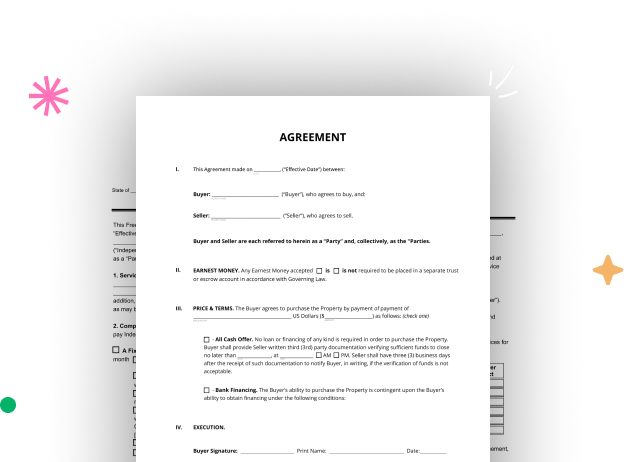



Create your US Child Custody Law from scratch

Start Building Now
Title decoration

Here's how it works

01. Start with a blank US Child Custody Law
Open the blank document in the editor, set the document view, and add extra pages if applicable.
02. Add and configure fillable fields
Use the top toolbar to insert fields like text and signature boxes, radio buttons, checkboxes, and more. Assign users to fields.
03. Distribute your form
Share your US Child Custody Law in seconds via email or a link. You can also download it, export it, or print it out.

A brief tutorial on how to build a professional-looking US Child Custody Law

Form edit decoration

Step 1: Log in to DocHub to create your US Child Custody Law.

First, log in to your DocHub account. If you don't have one, you can simply sign up for free.

Step 2: Go to the dashboard.

Once you’re in, navigate to your dashboard. This is your main hub for all document-focused activities.

Step 3: Initiate new document creation.

In your dashboard, hit New Document in the upper left corner. Opt for Create Blank Document to design the US Child Custody Law from a blank slate.

Step 4: Incorporate form elements.

Place numerous elements like text boxes, photos, signature fields, and other interactive areas to your form and assign these fields to certain recipients as needed.

Step 5: Personalize your form.

Refine your template by adding guidelines or any other necessary information utilizing the text feature.

Step 6: Go over and adjust the form.

Carefully check your created US Child Custody Law for any typos or required adjustments. Utilize DocHub's editing features to enhance your form.

Step 7: Distribute or download the form.

After completing, save your copy. You can opt to keep it within DocHub, transfer it to various storage platforms, or forward it via a link or email.


be ready to get more

Build your US Child Custody Law in minutes

Start creating now

Got questions?

We have answers to the most popular questions from our customers. If you can't find an answer to your question, please contact us.
Contact us
Its not impossible, however, and there are several steps that you can take to help your case. We have included helpful links to resources regarding child custody for fathers below our infographic. The True Facts About Child Custody for Men in The US: Fathers are granted custody only 18.3% of the time.
The deciding factors will vary with the facts of each case, but the courts will always look to what is in the best interest of the child. Specifically, the court will consider evidence relating to the childs needs and each parents ability to meet those needs, and will award custody ingly.
Child custody following divorce of the parents is to be decided ing to the best interests of the child. The law directs that mothers and fathers be treated equally. Neither parent has an automatic preference for custody of children based on the sex of the parent.
Italy StateYearType Connecticut 2017 Presumption, 50/50 Florida 2016 Presumption, 50/50 Georgia 2020 Presumption, Equal or approximately equal Hawaii 2014 Presumption, 50/5048 more rows
State by state rankings RankStatePct # 24 California 32.8% # 25 Hawaii 31% # 26 New York 30.4% # 27 Indiana 28.8%13 more rows Jun 5, 2018
be ready to get more

Build your US Child Custody Law in minutes

Start creating now

Related Q&A to US Child Custody Law

Statistics show that women win child custody rights a staggering 90% of the time , even though fathers play an important role in their childrens lives pre and post-divorce.
All states use a best interest of the child standard in disputed custody cases.
For one parent to gain sole custody, there must be a reason that it is not in the childs interests to be in the custody of the other parent. Sole custody is more likely in circumstances where: One parent is a legally unfit parent. A parent has a history of abuse, domestic violence, or child neglect.
In the United States, most states do not have a minimum age requirement for a child to be eligible for custody. However, for example in Georgia, a child must be at least 14 years old to choose their physical custodian.

Additional resources on building your forms


