Enhance your document management with United States Legal Motions

Your workflows always benefit when you can easily get all the forms and documents you need at your fingertips. DocHub delivers a wide array of form templates to alleviate your day-to-day pains. Get a hold of United States Legal Motions category and quickly browse for your form.

Begin working with United States Legal Motions in several clicks:

  1. Gain access to United States Legal Motions and get the form you require.
  2. Click on Get Form to open it in our online editor.
  3. Begin editing your document: add more fillable fields, highlight sentences, or blackout sensitive info.
  4. The application saves your adjustments automatically, and once you are ready, you are able to download or distribute your file with other contributors.

Enjoy fast and easy form management with DocHub. Discover our United States Legal Motions collection and get your form right now!


Video Guide on United States Legal Motions management

video background

Commonly Asked Questions about United States Legal Motions

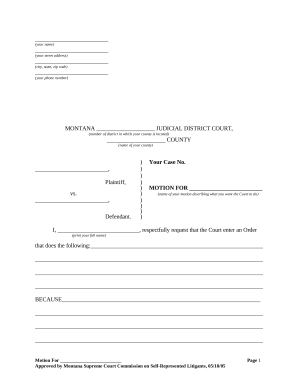
A motion is an application to the court made by the prosecutor or defense attorney, requesting that the court make a decision on a certain issue before the trial begins. The motion can affect the trial, courtroom, defendants, evidence, or testimony. Only judges decide the outcome of motions.
A motion is filed to get a court ruling on an issue. Examples are a Motion for Summary Judgment, Motion for Judgment of Acquittal, or Motion to Dismissal. A Request is less common, but is filed when the party has failed to Answer the Complaint and a party files a Request for Order of Default.
A motion to recuse is a legal motion filed in court that says a judge should be disqualified, or removed, from a legal case for a reason listed within CCP 170.1. The motion can be brought by either a prosecutor or a defense attorney.
In United States law, a motion is a procedural device to bring a limited, contested issue before a court for decision. It is a request to the judge (or judges) to make a decision about the case.
A motion is the method used to speak to the judge about a matter in your case. For example, a motion may be brought to ask the court to set aside a default or vacate a default judgment, or it may be brought to ask the court to order a judgment to be paid in installments.
Types of Legal Motions in California Law Commonly used motion types in the state of California include motions to compel discovery, motions to dismiss, motions for summary judgment, and motions in limine.
Among the most common pre-trial motions include: Motion to Suppress: This motion attempts to restrict certain statements and evidence from being introduced as evidence at trial. Motion to Discover. Motion to Dismiss: An attempt to get the judge to dismiss a charge or case altogether.
An Order is a separate document that a judge signs which sets forth the judges ruling on a motion.