Get and manage Trust Administration online

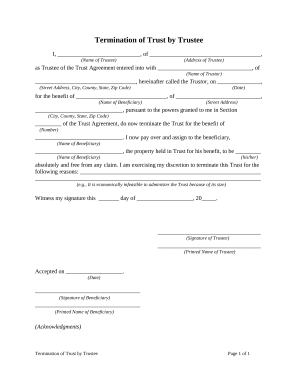
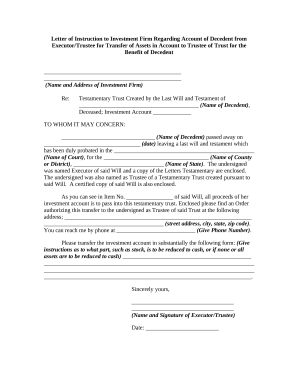
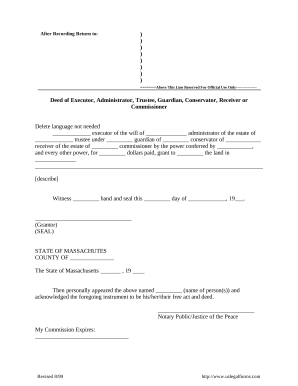
Improve your form operations with our Trust Administration category with ready-made document templates that meet your requirements. Access your form, alter it, fill it, and share it with your contributors without breaking a sweat. Start working more effectively with your documents.

The best way to use our Trust Administration:

  1. Open our Trust Administration and look for the form you need.
  2. Preview your form to ensure it’s what you want, and click Get Form to start working on it.
  3. Alter, add new text, or point out important information with DocHub tools.
  4. Fill out your form and preserve the changes.
  5. Download or share your form template with other recipients.

Explore all of the possibilities for your online document management with our Trust Administration. Get a totally free DocHub profile today!


Video Guide on Trust Administration management

video background

Commonly Asked Questions about Trust Administration

A trustee is the person in charge of a trust. An administrator is the person appointed by the probate court to oversee a decedents estate when there is no will. An executor is the person appointed by the probate court to oversee a decedents estate when the will has been admitted to probate. What Is The Difference Between A Trustee, Administrator and Executor? Steburg Law Firm P.C. faq what-is-the-diff Steburg Law Firm P.C. faq what-is-the-diff
As a trust administrator, your clients expect you to make decisions in good faith that are in their best interest financially. Your job duties include opening and closing accounts and setting up trust funds, beneficiaries, and deed documents ing to state and federal regulations. Trust Administrator: What Is It? and How to Become One? ZipRecruiter career What-Is-How-to- ZipRecruiter career What-Is-How-to-
Trust administration refers to the tasks associated with managing the assets, distributions, and filings of a trust. trust administration | Wex - Law.Cornell.Edu LII / Legal Information Institute Wex LII / Legal Information Institute Wex
A trust can be created while the grantor is alive, while an estate is created at the moment of someones death. A trust is intended to be a semi-permanent entity. It exists to distribute assets over time ing to a series of rules and conditions, overseen by a trustee. An estate is intended to be temporary. Estate vs. Trust: Whats the Difference? - SmartAsset SmartAsset estate-planning estate-vs-trust SmartAsset estate-planning estate-vs-trust
An estate establishes a one-time transfer after a person dies, whereas a trust establishes a continuous transfer that can begin before or after a persons death. What Is the Difference Between a Trust and an Estate? rgpattorney.com what-is-difference-betwe rgpattorney.com what-is-difference-betwe
A trust fund is a legal entity that holds property and assets and can provide financial, tax, and legal protections. A grantor sets it up and funds it with money or assets. One or more beneficiaries receive the assets under specified terms. The trustee manages the trust and distributes its assets at a prescribed time. What Is a Trust Fund and How Does It Work? - Investopedia Investopedia terms trust-fund Investopedia terms trust-fund
Generally, an executor administers the estate of the person who died, while a trustee administers a trust for the benefit of the named beneficiaries. The Difference Between a Trustee, Guardian and Executor City National Bank personal-banking insights tru City National Bank personal-banking insights tru
Definition: To be clear, Estates and Trusts share very few similarities. While an Estate is merely the total value of a persons assets after they pass away, a Trust is a legal entity designed to hold, manage and distribute assets on behalf of beneficiaries. Difference Between Estate vs. Trust | Trust Will Trust Will learn estate-vs-trust Trust Will learn estate-vs-trust