
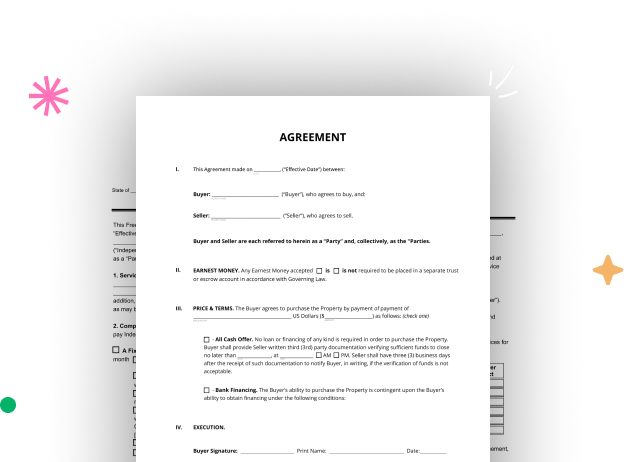
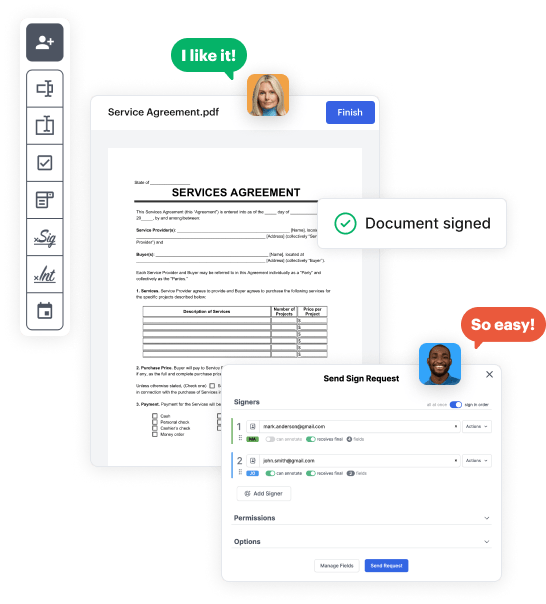
Create your Title Confirmation Legal Document from scratch

Start Building Now
Title decoration

Here's how it works

01. Start with a blank Title Confirmation Legal Document
Open the blank document in the editor, set the document view, and add extra pages if applicable.
02. Add and configure fillable fields
Use the top toolbar to insert fields like text and signature boxes, radio buttons, checkboxes, and more. Assign users to fields.
03. Distribute your form
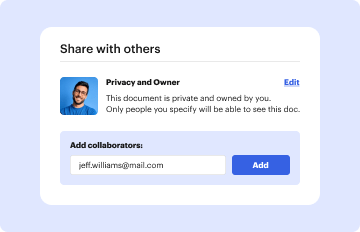
Share your Title Confirmation Legal Document in seconds via email or a link. You can also download it, export it, or print it out.

A quick guide on how to create a professional-looking Title Confirmation Legal Document

Form edit decoration

Step 1: Log in to DocHub to begin creating your Title Confirmation Legal Document.

First, log in to your DocHub account. If you don't have one, you can simply register for free.

Step 2: Head to the dashboard.

Once you’re in, navigate to your dashboard. This is your primary hub for all document-focused tasks.

Step 3: Initiate new document creation.

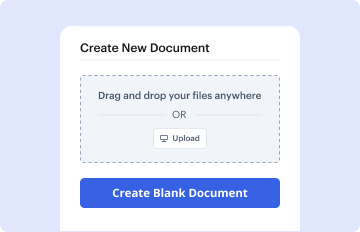
In your dashboard, hit New Document in the upper left corner. Hit Create Blank Document to create the Title Confirmation Legal Document from the ground up.

Step 4: Insert form elements.

Place different fields like text boxes, images, signature fields, and other interactive areas to your form and designate these fields to particular individuals as required.

Step 5: Adjust your form.

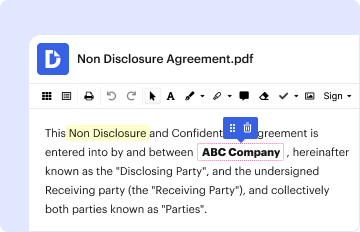
Personalize your template by inserting guidelines or any other crucial information utilizing the text tool.

Step 6: Double-check and modify the form.

Carefully review your created Title Confirmation Legal Document for any discrepancies or necessary adjustments. Utilize DocHub's editing features to perfect your form.

Step 7: Distribute or export the form.

After finalizing, save your copy. You can select to retain it within DocHub, export it to various storage solutions, or forward it via a link or email.


be ready to get more

Build your Title Confirmation Legal Document in minutes

Start creating now

Got questions?

We have answers to the most popular questions from our customers. If you can't find an answer to your question, please contact us.
Contact us
Documents of title play an important role in facilitating commercial transactions for the sale of goods, especially during the transport and storage stages of the transaction and in relation to obtaining finance for the transaction. Typical examples include bills of lading, warehouse receipts and sea or air waybills.
All templates are carefully reviewed by practicing lawyers, and the company is fully accredited with the Better Business Bureau (BBB) and maintains an A+ rating.
Legal Templates is a Free Online Legal Form Document Creator.
Pros: A great product that does not break the bank for small businesses. I can look at a document without having to pay my lawyer to give me a rough draft. I know everything I need in advance. Cons: I feel the software uses type-face and no state logo forms.
More Best Legal Services Overall: Rocket Lawyer Best Budget Legal Services: LegalShield Best Legal Services for Small Businesses: ZenBusiness Best for Business Formation: Bizee Best for IP Protection: : Best for Self-Service Legal Documents: Nolo Best for Outsourcing Legal Operations: UpCounsel
be ready to get more

Build your Title Confirmation Legal Document in minutes

Start creating now

Related Q&A to Title Confirmation Legal Document

Today, is a leading publisher of do-it-yourself legal documents around the world. Were based in Alberta, Canada, with offices in the United States and the United Kingdom. We proudly provide services in these countries, plus Australia, France, Germany, India, Ireland, New Zealand, Nigeria, and Singapore.
The requirements for paper size can vary by country, but the U.S. follows the American National Standards Institute (ANSI) standards. Unlike the common paper size that most people use day-to-day, which is 8.5 x 11 inches, legal paper is larger at 8.5 x 14 inches. Junior legal size is smaller at 5 x 8 inches.
A legal document is a written instrument that records and formalizes an agreement, obligation, or other legally enforceable act. It is a communication tool in the legal sphere designed to express and enforce rights, responsibilities, or procedures under the law.


