Manage Timber Sale Contract Forms effortlessly online

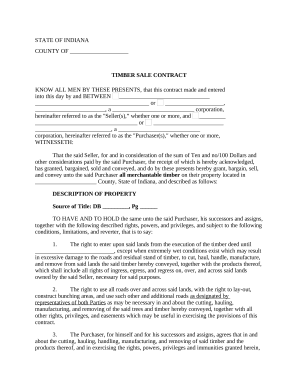
Document managing can stress you when you can’t find all the documents you require. Fortunately, with DocHub's extensive form categories, you can find everything you need and easily handle it without changing among apps. Get our Timber Sale Contract Forms and begin utilizing them.

The best way to manage our Timber Sale Contract Forms using these easy steps:

  1. Check Timber Sale Contract Forms and select the form you require.
  2. Preview the template and then click Get Form.
  3. Wait for it to open in our online editor.
  4. Change your form: add new information and pictures, and fillable fields or blackout some parts if necessary.
  5. Fill out your form, preserve modifications, and prepare it for sending.
  6. When you are ready, download your form or share it with other contributors.

Try out DocHub and browse our Timber Sale Contract Forms category without trouble. Get your free profile right now!


Video Guide on Timber Sale Contract Forms management

video background

Commonly Asked Questions about Timber Sale Contract Forms

How to enter Timber Sale Income For What type of investment did you sell? For Description enter Timber, For When did you receive this investment?, use the date you acquired the timber property. For cost basis, see Determining Timber Cost Basis | MU Extension or use another method that you can justify.
How to report sale of lumber using Ordinary Income: If you receive income from the sale of lumber, logs or other products produced by the timber itself then you report that income as Ordinary Income. It is also considered Ordinary Income if you sell non-timber forest products such as moss, ferns or medicinal products.
How to report sale of lumber using Capital Gains- Schedule D: You may receive income by cutting timber and opting to treat that cutting as a sale, or by disposing of standing timber, which is known as stumpage. In this case the income is treated as a Capital Gain and is reported by the taxpayer on their Schedule D.
There are three common types of payments involved in a timber sale contract: lump sum, per unit, and blended price. The lump sum payment is the simplest type. The landowner and timber buyer negotiate upfront, or by means of a sealed bid, a set price for the timber that will be harvested.
Report on Form 1099-S payments of timber royalties made under a pay-as-cut contract, reportable under section 6050N. For more information, see Announcement 90-129, 1990-48 I.R.B.
Timber is generally sold by one of two methods: negotiation or sealed bid. You should seek the advice of your registered consulting forester to determine which method best achieves your harvesting objectives. between you (the seller) and the buyer.
If you held the timber for more than one year before selling it you should report the total amount received for the timber on Form 1040, Schedule D, Part II, column (d). You may be able to recover your cost basis in the timber sold, also referred to as a depletion allowance.
The timber yield tax is a property tax based on the value of your standing timber. Other taxes, including sales tax and state and federal income tax, may apply to your operation.