
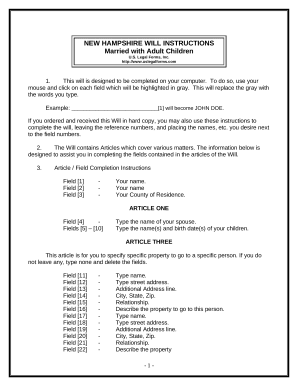
Improve your document management with Testament Form for Adult Children

Your workflows always benefit when you are able to discover all of the forms and documents you need at your fingertips. DocHub delivers a a huge collection of templates to ease your everyday pains. Get hold of Testament Form for Adult Children category and quickly find your form.

Start working with Testament Form for Adult Children in a few clicks:

  1. Browse Testament Form for Adult Children and locate the form you require.
  2. Click on Get Form to open it in our editor.
  3. Start adjusting your form: add fillable fields, highlight paragraphs, or blackout sensitive information and facts.
  4. The app saves your modifications automatically, and once you are ready, you can download or distribute your form with other contributors.

Enjoy easy form administration with DocHub. Explore our Testament Form for Adult Children online library and look for your form right now!


Video Guide on Testament Form for Adult Children management

video background

Commonly Asked Questions about Testament Form for Adult Children

For example, you might write, I, [full name], living at [full address], declare this to be my last will and testament, and I revoke any and all wills and codicils made prior to this date. All references herein to this will refer solely to this document.
I, , a resident in the City of , County of , State of , being of sound mind, not acting under duress or undue influence, and fully understanding the nature and extent of all my property and of this disposition thereof, hereby make,
A will, or a last will and testament, is a legal document that describes how you would like your property and other assets to be distributed after your death.
What is a simple will? State that the document is your will and reflects your final wishes. Name the people you want to inherit your property after you die. Choose someone to carry out the wishes in your will. Name guardians to care for your minor children or pets, if you have them. Sign your will in front of witnesses.
When a will only deals with real property, it may be called a devise, and when a will only deals with personal property, it may be called a testament. If a decedent does not leave a last will and testament, their assets will be administered by a probate court.
I pray to remove any strongholds in their lives that would cause them to seek peace and salvation in any way other than through Jesus Christ. Father, surround them with your grace, love, and protection. In times of joy, let them recognize your blessings, and in times of challenge, grant them resilience and faith.
How to create a last will and testament in six steps Step 1: Make detailed property records. Step 2: Name an executor. Step 3: Add beneficiaries and designate property. Step 4: Formalize your will on paper. Step 5: Sign the document. Step 6: Maintain and update the document as needed.
