
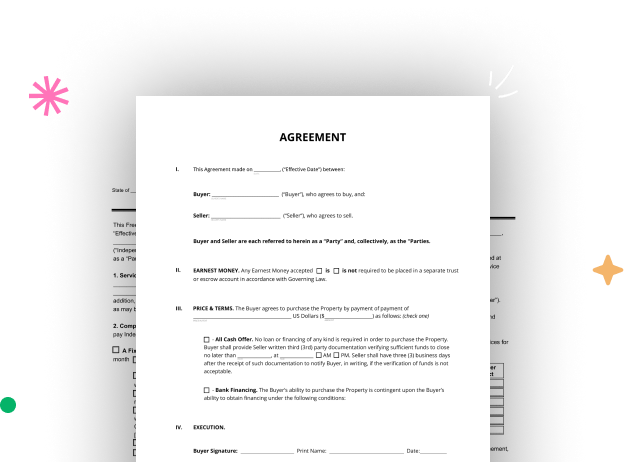
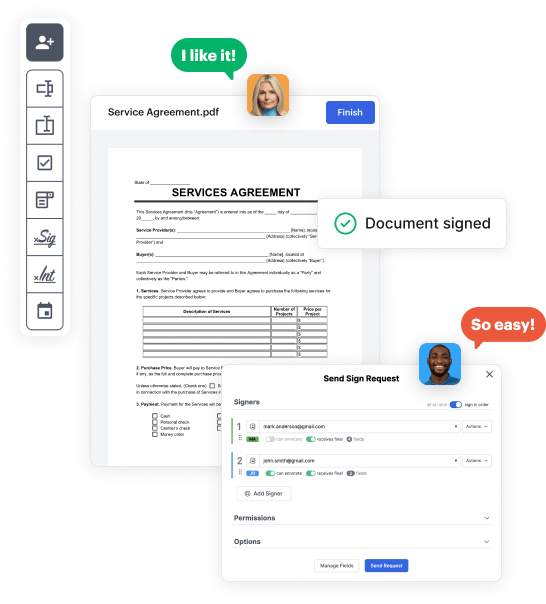
Create your Residential Property Transfer Form from scratch

Start Building Now
Title decoration

Here's how it works

01. Start with a blank Residential Property Transfer Form
Open the blank document in the editor, set the document view, and add extra pages if applicable.
02. Add and configure fillable fields
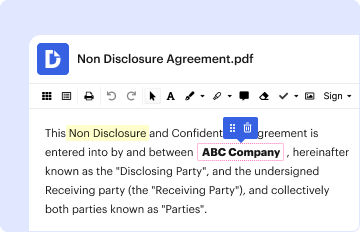
Use the top toolbar to insert fields like text and signature boxes, radio buttons, checkboxes, and more. Assign users to fields.
03. Distribute your form
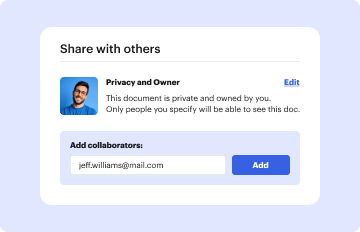
Share your Residential Property Transfer Form in seconds via email or a link. You can also download it, export it, or print it out.

A simple tutorial on how to create a polished Residential Property Transfer Form

Form edit decoration

Step 1: Sign in to DocHub to begin creating your Residential Property Transfer Form.

First, sign in to your DocHub account. If you don't have one, you can simply sign up for free.

Step 2: Navigate to the dashboard.

Once logged in, head to your dashboard. This is your primary hub for all document-based operations.

Step 3: Launch new document creation.

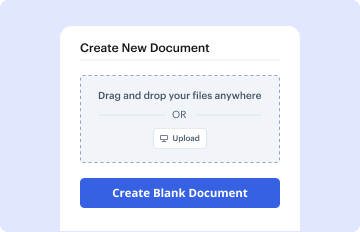
In your dashboard, click on New Document in the upper left corner. Opt for Create Blank Document to put together the Residential Property Transfer Form from a blank slate.

Step 4: Insert template fillable areas.

Place numerous elements like text boxes, photos, signature fields, and other fields to your template and assign these fields to intended users as necessary.

Step 5: Personalize your form.

Personalize your template by adding walkthroughs or any other necessary information using the text tool.

Step 6: Review and correct the document.

Thoroughly go over your created Residential Property Transfer Form for any inaccuracies or necessary adjustments. Take advantage of DocHub's editing capabilities to polish your form.

Step 7: Share or export the form.

After finalizing, save your file. You can opt to save it within DocHub, transfer it to various storage services, or forward it via a link or email.


be ready to get more

Build your Residential Property Transfer Form in minutes

Start creating now

Got questions?

We have answers to the most popular questions from our customers. If you can't find an answer to your question, please contact us.
Contact us
To change a deed in New York City, you will need a deed signed and docHubd by the grantor. The deed must also be filed and recorded with the Office of the City Register. Transfer documents identifying if any taxes are due must also be filed and recorded with the City Register.
How do I add/remove a name on a Deed? You would have to record a new deed adding or removing the person(s) name. Because it is a legal document with legal consequences, we HIGHLY advise you work with an attorney to do so.
To successfully file a quit claim deed in New York, you will need to fulfill a few essential qualifications: Written consent from both parties via Form TP-584 and Form RP-5217 (oral agreements do not qualify) Official notarization of forms. Payment of associated fees. Payment of any taxes owed on the property.
Form TP-584 must be filed for each conveyance of real property from a grantor/transferor to a grantee/transferee. It may not be necessary to complete all the schedules on Form TP-584. The nature and condition of the conveyance will determine which of the schedules you must complete.
Unfortunately, once a deed is recorded in New York State, it cant simply be amended or modified. A new deed must be recorded to change ownership.
be ready to get more

Build your Residential Property Transfer Form in minutes

Start creating now

Related Q&A to Residential Property Transfer Form

The filing fee is generally $125 for residential and farm properties and $250 for all other properties. The county clerks office collects the RP-5217 filing fee. The county clerks office should be reviewing the RP-5217 forms for completeness, not for accuracy.
What are the New York Transfer Tax Rates? The New York State transfer tax is 0.4% for properties below $3,000,000 and 0.65% for those $3,000,000 and up. The New York City transfer tax is 1% for properties below $500,000 and 1.425% for those $500,000 and up.

Additional resources on building your forms