


Create your Residential Property Deed from scratch

Start Building Now
Title decoration

Here's how it works

01. Start with a blank Residential Property Deed
Open the blank document in the editor, set the document view, and add extra pages if applicable.
02. Add and configure fillable fields
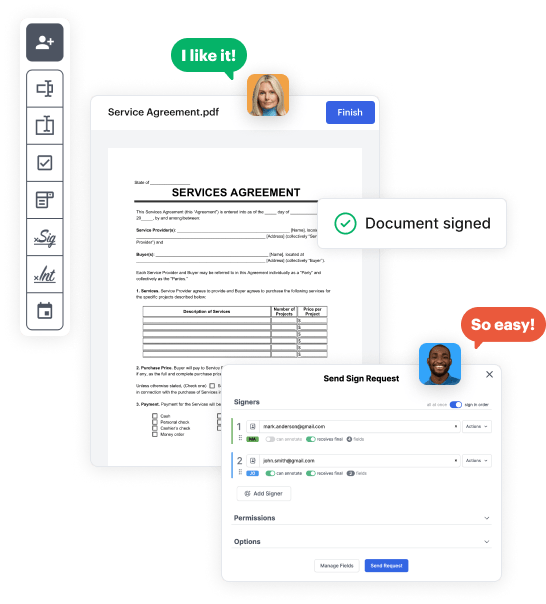
Use the top toolbar to insert fields like text and signature boxes, radio buttons, checkboxes, and more. Assign users to fields.
03. Distribute your form
Share your Residential Property Deed in seconds via email or a link. You can also download it, export it, or print it out.

Build Residential Property Deed from the ground up by following these comprehensive guidelines

Form edit decoration

Step 1: Start off by launching DocHub.

Start by setting up a free DocHub account using any available sign-up method. Just log in if you already have one.

Step 2: Register for a free 30-day trial.

Try out the complete suite of DocHub's advanced features by signing up for a free 30-day trial of the Pro plan and proceed to build your Residential Property Deed.

Step 3: Build a new empty document.

In your dashboard, choose the New Document button > scroll down and choose to Create Blank Document. You’ll be taken to the editor.

Step 4: Organize the document’s view.

Use the Page Controls icon marked by the arrow to switch between two page views and layouts for more convenience.

Step 5: Begin by inserting fields to design the dynamic Residential Property Deed.

Navigate through the top toolbar to place document fields. Add and arrange text boxes, the signature block (if applicable), embed images, etc.

Step 6: Prepare and configure the added fields.

Organize the fillable areas you added per your chosen layout. Modify each field's size, font, and alignment to make sure the form is user-friendly and neat-looking.

Step 7: Finalize and share your document.

Save the finalized copy in DocHub or in platforms like Google Drive or Dropbox, or design a new Residential Property Deed. Share your form via email or get a public link to reach more people.


be ready to get more

Build your Residential Property Deed in minutes

Start creating now

Got questions?

We have answers to the most popular questions from our customers. If you can't find an answer to your question, please contact us.
Contact us
Once a deed has been recorded by the County Clerks Office, copies of the deed may be requested if the original deed has been misplaced. Plain copies can be found by using the Official Public Records Search and selecting Land Records. A certified copy may be purchased through request either in person or by mail.
Mississippi law requires a signed deed to be delivered to the new owner to become effective. Delivery by the current owner to the chancery clerk for recording is considered constructive delivery to the new owner.
A deed must identify the current owner, new owner, and any other parties to the deed. The parties must be identified by name, mailing address, and telephone number. The identifying information must be on the first page below the 3-inch top margin. Property description or indexing information.
A deed is an official written document declaring a persons legal ownership of a property, while a title is a legal concept that refers to ownership rights. Heres a way to remember the difference: You can own a physical copy of a book, but you cant hold the books title in your hand.
Property ownership information can be requested from the County Registrar-Recorder/County Clerk. For more information, please visit their website to Request a Real Estate Record.
be ready to get more

Build your Residential Property Deed in minutes

Start creating now

Related Q&A to Residential Property Deed

91-27-1 and following.) You must sign the deed and get your signature docHubd, and then record (file) the deed with the county chancery clerks office before your death. Otherwise, it wont be valid.
For a deed to be valid, it must contain several essential elements, including the operative words of conveyance, description of the property, signatures, delivery, proper formatting and execution, absence of defects and encumbrances, legal capacity of parties, proper recording, and voluntary execution.
DEEDS IN GENERAL It must be in writing; 2. The parties must be properly described; 3. The parties must be competent to convey and capable of receiving the grant of the property; 4. The property conveyed must be described so as to distinguish it from other parcels of real property.; 5.

Additional resources on building your forms


