Get and manage Real Estate Subordination Agreements online

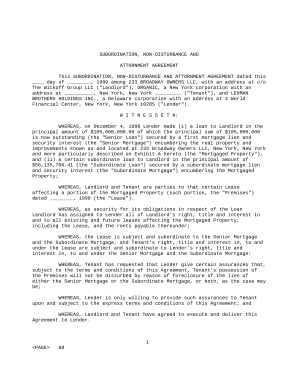
Speed up your file managing using our Real Estate Subordination Agreements category with ready-made document templates that meet your needs. Get the document template, modify it, complete it, and share it with your contributors without breaking a sweat. Begin working more efficiently together with your forms.

The best way to manage our Real Estate Subordination Agreements:

  1. Open our Real Estate Subordination Agreements and search for the form you want.
  2. Preview your form to ensure it’s what you want, and click on Get Form to start working on it.
  3. Edit, add new text, or highlight important information with DocHub tools.
  4. Prepare your form and preserve the modifications.
  5. Download or share your form with other recipients.

Explore all of the possibilities for your online document management with our Real Estate Subordination Agreements. Get a totally free DocHub account right now!

Video Guide on Real Estate Subordination Agreements management

video background

Commonly Asked Questions about Real Estate Subordination Agreements

There are two types of subordination agreements: Subordinated Loan Agreement (SLA) An SLA is used when you lend cash to a firm. Secured Demand Note Agreement (SDN) An SDN is a promissory note in which you agree to give cash to the firm on demand (i.e., without prior notice) during the term of the note.
In most cases, subordinate clauses are used when a property owner takes on a second position loan, such as a mezzanine loan, a supplemental loan, or preferred equity, on top of their original first position mortgage.
Subordination is the process of ranking home loans (mortgage, HELOC or home equity loan) by order of importance. When you have a home equity line of credit, for example, you actually have two loans your mortgage and HELOC. Both are secured by the collateral in your home at the same time.
The refinancing lender will probably require a subordination agreement from the second mortgage lender as part of the process. The subordination agreement adjusts the priority of the new and older second mortgage to ensure that the refinancing lender gets paid first if a foreclosure happens.
Example of a Subordination Agreement A standard subordination agreement covers property owners that take a second mortgage against a property. One loan becomes the subordinated debt, and the other becomes (or remains) the senior debt. Senior debt has higher claim priority than junior debt.
A subordination agreement is generally used when there are two mortgages and the mortgagor needs to refinance the first mortgage. It acknowledges that one partys interest or claim is superior to another in case the borrowers assets need to be liquidated to repay debts.
Subordination agreements can help to establish a clear lien position hierarchy. This can be useful in the event of debt repayment scenarios like foreclosure. The need for a subordination agreement may arise when there are multiple loans on a property.
A subordination agreement prioritizes debts, ranking one behind another for purposes of collecting repayment from a debtor in the event of foreclosure or bankruptcy. A second-in-line creditor collects only when and if the priority creditor has been fully paid.