

Create your Real Estate Rental Law from scratch

Start Building Now
Title decoration

Here's how it works

01. Start with a blank Real Estate Rental Law
Open the blank document in the editor, set the document view, and add extra pages if applicable.
02. Add and configure fillable fields
Use the top toolbar to insert fields like text and signature boxes, radio buttons, checkboxes, and more. Assign users to fields.
03. Distribute your form
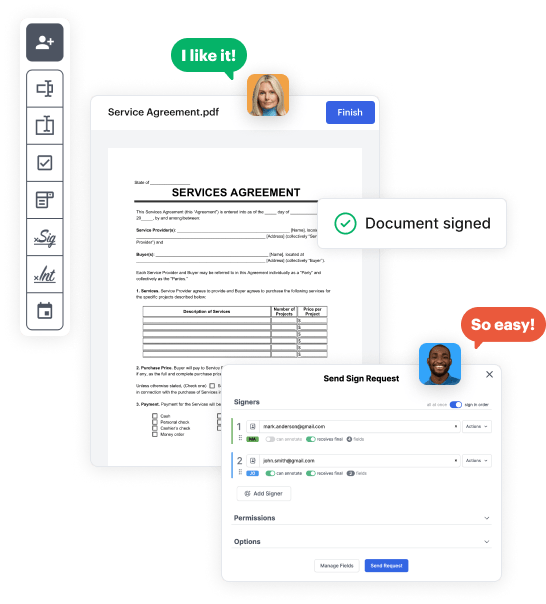
Share your Real Estate Rental Law in seconds via email or a link. You can also download it, export it, or print it out.

A detailed walkthrough of how to craft your Real Estate Rental Law online

Form edit decoration

Step 1: Start with DocHub's free trial.

Navigate to the DocHub website and sign up for the free trial. This gives you access to every feature you’ll require to build your Real Estate Rental Law with no upfront cost.

Step 2: Navigate to your dashboard.

Log in to your DocHub account and go to the dashboard.

Step 3: Initiate a new document.

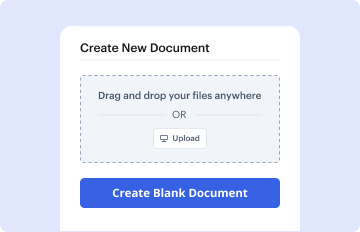
Click New Document in your dashboard, and select Create Blank Document to design your Real Estate Rental Law from the ground up.

Step 4: Use editing tools.

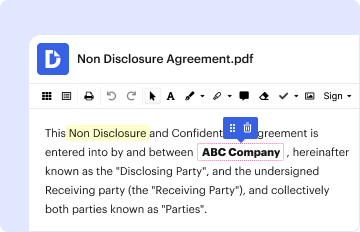
Insert different fields such as text boxes, radio buttons, icons, signatures, etc. Arrange these fields to match the layout of your form and designate them to recipients if needed.

Step 5: Organize the form layout.

Organize your form in seconds by adding, moving, deleting, or merging pages with just a few clicks.

Step 6: Set up the Real Estate Rental Law template.

Convert your freshly crafted form into a template if you need to send many copies of the same document repeatedly.

Step 7: Save, export, or share the form.

Send the form via email, share a public link, or even publish it online if you want to collect responses from more recipients.


be ready to get more

Build your Real Estate Rental Law in minutes

Start creating now

Got questions?

We have answers to the most popular questions from our customers. If you can't find an answer to your question, please contact us.
Contact us
Under the new Good Cause Eviction law, New Yorkers have the right to continue living in their homes without fear of unreasonable eviction or extreme rent increases. In many situations, tenants of market rate housing will now be covered by more expansive protections. Read below for details.
Effective March 20, 2024, the amended New York Real Property Law Chapter 50, Article 14 (the Property Condition Disclosure Act) will compel all sellers of residential property to complete and deliver a Property Condition Disclosure Statement (PCDS) to a buyer prior to signing a contract of sale.
Specifically, the New York City Human Rights Law prohibits discrimination in housing based on actual or perceived race, creed, color, national origin, gender, age, disability, sexual orientation, uniformed service, marital status, partnership status, alienage or citizenship status of any person or group of persons, or
223-a. Remedies of lessee when possession is not delivered. In the absence of an express provision to the contrary, there shall be implied in every lease of real property a condition that the lessor will deliver possession at the beginning of the term.
Amended PCDS Required If the seller has already provided the PCDS to the buyer and the buyer has not signed the PCDS prior to March 20, 2024, the amended PCDS is required. If the seller has not provided the PCDS and a binding contract of sale is entered into on or after March 20, 2024, the amended PCDS is required.
be ready to get more

Build your Real Estate Rental Law in minutes

Start creating now

Related Q&A to Real Estate Rental Law

For a two-year lease beginning on or after October 1, 2023, and on or before September 30, 2024: For the first year of the lease: 2.75% For the second year of the lease: 3.20% of the amount lawfully charged in the first year, excluding any increases other than the first-year guideline increase.
Waiving the Warranty of Habitability (Real Property Law 235-b); and. Restricting a tenant from living with their immediate family members and/or one additional occupant and the occupants dependent children (Real Property Law 235-f).

Additional resources on building your forms


