
Create your Professional Employment Agreement from scratch

Start Building Now
Title decoration

Here's how it works

01. Start with a blank Professional Employment Agreement
Open the blank document in the editor, set the document view, and add extra pages if applicable.
02. Add and configure fillable fields
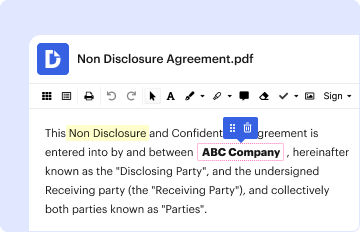
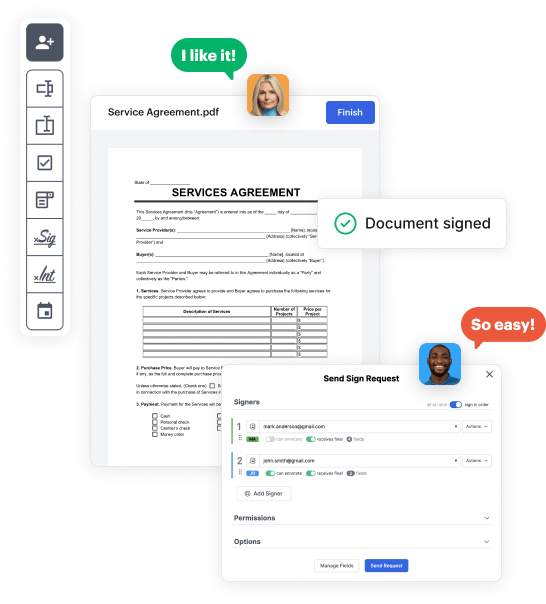
Use the top toolbar to insert fields like text and signature boxes, radio buttons, checkboxes, and more. Assign users to fields.
03. Distribute your form
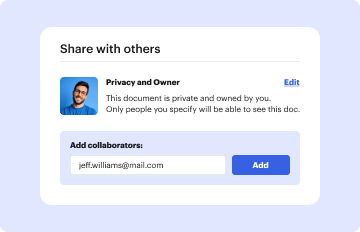
Share your Professional Employment Agreement in seconds via email or a link. You can also download it, export it, or print it out.

Build Professional Employment Agreement from scratch by following these detailed guidelines

Form edit decoration

Step 1: Open DocHub and get going.

Begin by setting up a free DocHub account using any offered sign-up method. Just log in if you already have one.

Step 2: Register for a 30-day free trial.

Try out the whole collection of DocHub's advanced tools by registering for a free 30-day trial of the Pro plan and proceed to craft your Professional Employment Agreement.

Step 3: Create a new empty doc.

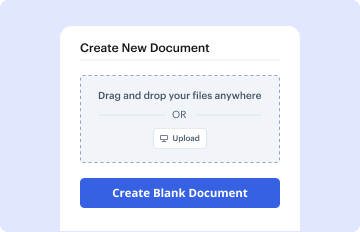
In your dashboard, select the New Document button > scroll down and hit Create Blank Document. You’ll be redirected to the editor.

Step 4: Organize the document’s layout.

Use the Page Controls icon marked by the arrow to toggle between two page views and layouts for more flexibility.

Step 5: Start adding fields to design the dynamic Professional Employment Agreement.

Explore the top toolbar to place document fields. Add and arrange text boxes, the signature block (if applicable), embed images, etc.

Step 6: Prepare and configure the added fields.

Configure the fields you added per your chosen layout. Customize each field's size, font, and alignment to ensure the form is user-friendly and neat-looking.

Step 7: Finalize and share your form.

Save the completed copy in DocHub or in platforms like Google Drive or Dropbox, or create a new Professional Employment Agreement. Share your form via email or get a public link to reach more people.


be ready to get more

Build your Professional Employment Agreement in minutes

Start creating now

Got questions?

We have answers to the most popular questions from our customers. If you can't find an answer to your question, please contact us.
Contact us
Following this step-by-step checklist will mean that you can write your contract with confidence: Know your parties. Agree on the terms. Set clear boundaries. Spell out the consequences. Specify how you will resolve disputes. Cover confidentiality. Check the legality of the contract. Open it up to negotiation.
For a contract to be legally binding, it must have 4 essential elements: An offer. Acceptance of material terms of the offer. Consideration by both parties.
An employment contract is an enforceable agreement between two parties that contains whatever terms and conditions of employment the parties agree upon and, when accepted, becomes controlling upon the employment relationship. The contract may be oral or written, express or implied (the latter terms are defined below).
Because an employment contract is legally binding for both parties, problems can arise when changes need to be made regarding the employment relationship. Legally binding. There is exposure to risk if any parts of the agreement are broken.
When creating an Employment Contract, you can include the following terms: The type and rate of compensation. The frequency of payment. Vacation time. Specified work hours. Specified work location. Employee responsibilities. Length of a probationary period. Confidentiality, non-solicitation, or non-competition clauses.
be ready to get more

Build your Professional Employment Agreement in minutes

Start creating now

Related Q&A to Professional Employment Agreement

Whether the employment relationship is at-will or pursuant to a written employment contract, parties are free to negotiate and set the terms and conditions of their relationship, so long as none of the provisions violate any federal, state or local law, rules or regulations governing the employment relationship (e.g.
Guide to writing contracts of employment Names of the parties. The full details of the business, and the employees full name and address. Employment contract start date. Employees job title and description. Workplace. Working hours. Probationary period. Salary. Deductions.
Illegality: If the contract involves illegal activities, its automatically void. For example, if you hire someone for a job that violates labor laws, the contract wont hold up in court.

Additional resources on building your forms