Create your Paternity Legal Form from scratch

Start Building Now
Title decoration

Here's how it works

01. Start with a blank Paternity Legal Form
Open the blank document in the editor, set the document view, and add extra pages if applicable.
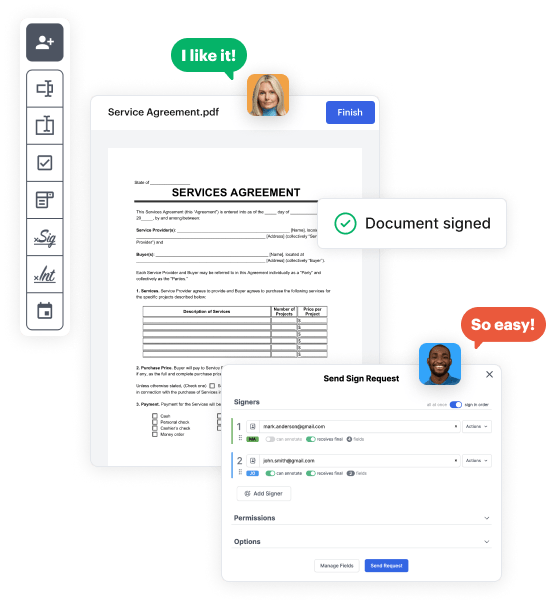
02. Add and configure fillable fields
Use the top toolbar to insert fields like text and signature boxes, radio buttons, checkboxes, and more. Assign users to fields.
03. Distribute your form
Share your Paternity Legal Form in seconds via email or a link. You can also download it, export it, or print it out.

Create your Paternity Legal Form in a matter of minutes
Form edit decoration

Step 1: Access DocHub to set up your Paternity Legal Form.

Start by accessing your DocHub account. Try out the advanced DocHub functionality free for 30 days.

Step 2: Navigate to the dashboard.

Once logged in, go to the DocHub dashboard. This is where you'll create your forms and manage your document workflow.

Step 3: Design the Paternity Legal Form.

Click on New Document and select Create Blank Document to be redirected to the form builder.

Step 4: Design the form layout.

Use the DocHub toolset to add and configure form fields like text areas, signature boxes, images, and others to your document.

Step 5: Add text and titles.

Add necessary text, such as questions or instructions, using the text tool to lead the users in your document.

Step 6: Configure field properties.

Modify the properties of each field, such as making them required or arranging them according to the data you expect to collect. Assign recipients if applicable.

Step 7: Review and save.

After you’ve managed to design the Paternity Legal Form, make a final review of your document. Then, save the form within DocHub, export it to your chosen location, or distribute it via a link or email.


be ready to get more

Build your Paternity Legal Form in minutes

Start creating now

Got questions?

We have answers to the most popular questions from our customers. If you can't find an answer to your question, please contact us.
Contact us
When a father signs a birth certificate, this acknowledges that hes the biological father of the child. However, this doesnt automatically establish legal paternity. The father must also complete a Voluntary Acknowledgment of Paternity (VAP) form, which is usually included with the birth certificate.
Paternity can be established by filing a civil action in circuit court. A judge can establish paternity by court order. We will ask the court to hear the case and then a judge decides whether or not paternity is established.
Statute of Limitations The time to commence a paternity proceeding under Article 5 of the Family Court Act is any time during the pregnancy of the mother, or after the child is born, but not after twenty one years, unless paternity is somehow acknowledged by the father, or he paid support.
You and the other parent can establish legal parentage for your child without going to court if you both parents sign a Voluntary Declaration of Parentage (VDOP) form and file it with the state. This form is usually signed at a hospital when a child is born. But you can sign it later.
Florida courts often order genetic tests to confirm paternity. These tests are highly accurate and can provide the concrete evidence needed to establish a legal father. The cost of these tests can range from $400 to $1,500 or more, depending on various factors.
be ready to get more

Build your Paternity Legal Form in minutes

Start creating now

Related Q&A to Paternity Legal Form

Fathers can do so from birth up to four years after the age of majority (18 years old). Fathers have a legal right to file to establish legal paternity which helps to guarantee that they can be a part of their childs life.
Filing for Paternity Testing in Florida: What You Need to Know Voluntary Acknowledgment: Both parents sign and docHub a form. Court-Ordered: File a petition in court, often with DNA testing. Florida Department of Revenue: Can assist with genetic testing at no cost.
The Parentage or Filiation Petition may be filed by the mother, the alleged father, intended legal parent, the child or its guardian. If the child is receiving cash assistance, the Department of Social Services will file a petition against the alleged parent, seeking an order of filiation and an order of support.

Additional resources on building your forms