
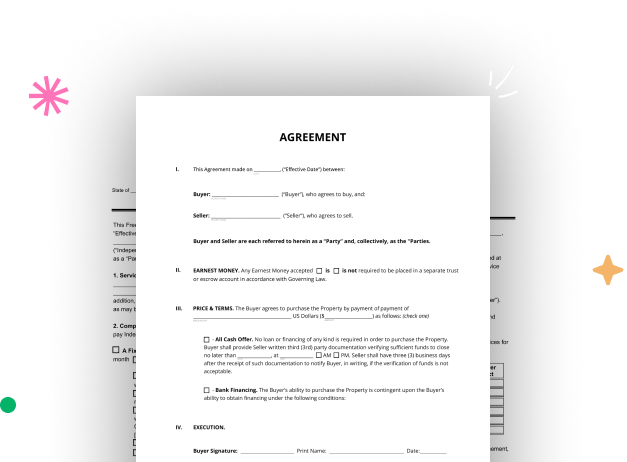

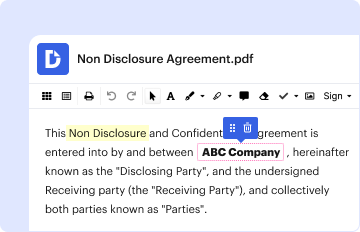

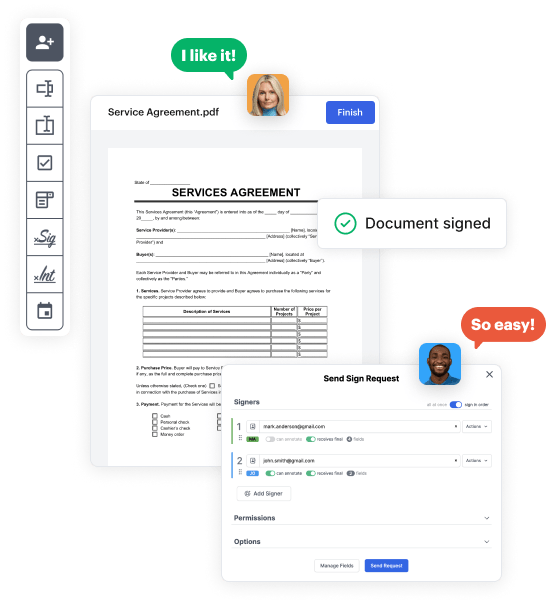
Create your Parental Legal Document from scratch

Start Building Now
Title decoration

Here's how it works

01. Start with a blank Parental Legal Document
Open the blank document in the editor, set the document view, and add extra pages if applicable.
02. Add and configure fillable fields
Use the top toolbar to insert fields like text and signature boxes, radio buttons, checkboxes, and more. Assign users to fields.
03. Distribute your form
Share your Parental Legal Document in seconds via email or a link. You can also download it, export it, or print it out.

A brief tutorial on how to set up a professional-looking Parental Legal Document

Form edit decoration

Step 1: Log in to DocHub to create your Parental Legal Document.

First, log in to your DocHub account. If you don't have one, you can simply sign up for free.

Step 2: Head to the dashboard.

Once logged in, access your dashboard. This is your primary hub for all document-focused tasks.

Step 3: Launch new document creation.

In your dashboard, select New Document in the upper left corner. Select Create Blank Document to craft the Parental Legal Document from the ground up.

Step 4: Incorporate form elements.

Add various items like text boxes, photos, signature fields, and other interactive areas to your form and designate these fields to intended recipients as required.

Step 5: Fine-tune your template.

Customize your document by including guidelines or any other vital information using the text option.

Step 6: Double-check and correct the form.

Carefully review your created Parental Legal Document for any typos or necessary adjustments. Leverage DocHub's editing tools to enhance your template.

Step 7: Share or export the template.

After finalizing, save your copy. You may opt to retain it within DocHub, export it to various storage options, or send it via a link or email.


be ready to get more

Build your Parental Legal Document in minutes

Start creating now

Got questions?

We have answers to the most popular questions from our customers. If you can't find an answer to your question, please contact us.
Contact us
Custody can be joint (shared by both parents) or sole (one parent has the primary decision-making authority). Parenting time/access pertains to the actual time a child spends with each parent.
A parent will be awarded custody if it is deemed to be in the best interests of the child. See Best Interests of the Child for more information on how courts determine the childs best interests. Paramount to any decisions regarding custody and access is stability.
If the couple is still married but separated, it is legal for both the parent to take the child. If the couple is divorced and the mother gets the sole physical custody, the father cannot take away the child. Sometimes, it becomes more complicated if you both share physical custody.
A child born out of wedlock is automatically given to the mother. However, the father might seek custody for several reasons. ing to the Supreme Court of Canada, an unmarried mother cannot simply move away from the childs father without his consent.
Generally, an unmarried parent who has the care and control of the child is considered the sole custodian without having to go to court. This is usually the mother of the child. A court may order otherwise if there is a child custody case to be heard.
be ready to get more

Build your Parental Legal Document in minutes

Start creating now

Related Q&A to Parental Legal Document

Unmarried Mothers Rights In the eyes of the law, unmarried mothers have sole legal and physical custody of their children. Unmarried mothers in Canada have the same rights as married mothers. They do not need to take any action to prove their eligibility for custody.
The maturity of each child, in addition to the bond between the child and each parent, are just as important as age. Our attorneys have seen 7 year olds handle a week on / week off schedule better than some 11 year old kids. With that being said, one blanket approach wont be beneficial for all.
Why do mothers win most custody battles? Mothers historically have won more custody battles due to traditional roles and perceptions of mothers as the primary caregivers.

Additional resources on building your forms