


Create your Ohio Rental Law from scratch

Start Building Now
Title decoration

Here's how it works

01. Start with a blank Ohio Rental Law
Open the blank document in the editor, set the document view, and add extra pages if applicable.
02. Add and configure fillable fields
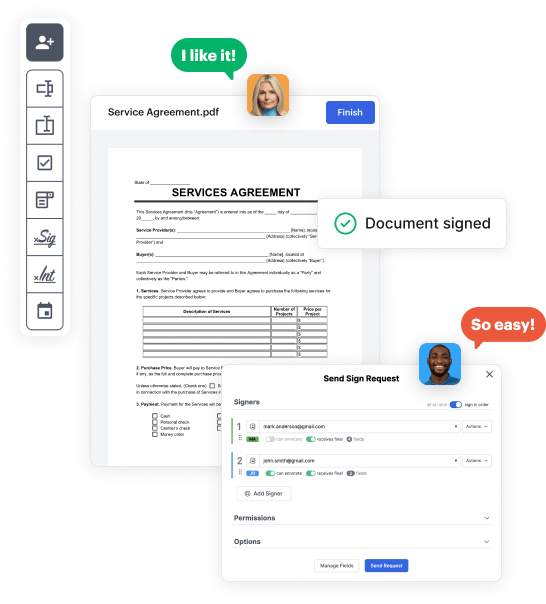
Use the top toolbar to insert fields like text and signature boxes, radio buttons, checkboxes, and more. Assign users to fields.
03. Distribute your form
Share your Ohio Rental Law in seconds via email or a link. You can also download it, export it, or print it out.

Craft Ohio Rental Law from the ground up by following these detailed instructions

Form edit decoration

Step 1: Open DocHub and get going.

Start by creating a free DocHub account using any available sign-up method. If you already have one, simply log in.

Step 2: Register for a free 30-day trial.

Try out the complete set of DocHub's pro tools by registering for a free 30-day trial of the Pro plan and proceed to craft your Ohio Rental Law.

Step 3: Build a new blank document.

In your dashboard, select the New Document button > scroll down and choose to Create Blank Document. You’ll be redirected to the editor.

Step 4: Organize the document’s layout.

Use the Page Controls icon marked by the arrow to toggle between different page views and layouts for more convenience.

Step 5: Begin by adding fields to create the dynamic Ohio Rental Law.

Explore the top toolbar to add document fields. Insert and format text boxes, the signature block (if applicable), add photos, and other elements.

Step 6: Prepare and customize the added fields.

Arrange the fields you added based on your desired layout. Personalize the size, font, and alignment to make sure the form is easy to use and neat-looking.

Step 7: Finalize and share your template.

Save the finalized copy in DocHub or in platforms like Google Drive or Dropbox, or create a new Ohio Rental Law. Send out your form via email or get a public link to engage with more people.


be ready to get more

Build your Ohio Rental Law in minutes

Start creating now

Got questions?

We have answers to the most popular questions from our customers. If you can't find an answer to your question, please contact us.
Contact us
(A) No landlord of residential premises shall initiate any act, including termination of utilities or services, exclusion from the premises, or threat of any unlawful act, against a tenant, or a tenant whose right to possession has terminated, for the purpose of recovering possession of residential premises, other than
There is no rent control in the state of Ohio. A landlord can raise the rent any amount as long as tenants are given notice before they sign the lease agreement or any renewal agreement. Ohio Landlord and Tenant Law - Fair Housing Contact Service Fair Housing Contact Service Fair Housing Contact Service PDF
Landlords cannot raise rent more than 10% total or 5% plus the percentage change in the cost of living whichever is lower over a 12-month period. Landlord-Tenant Issues | State of California - Department of Justice California Department of Justice - CA.gov California Department of Justice - CA.gov
As used in this chapter: (A) Tenant means a person entitled under a rental agreement to the use and occupancy of residential premises to the exclusion of others.
A real estate license is requiredyou are a person who, for another and for a fee, operates, manages, rents, offers, or attempts to operate, manage, or rent, other than as a custodian, care- taker, or janitor, any building or options of build- ings to the public as tenants.
be ready to get more

Build your Ohio Rental Law in minutes

Start creating now

Related Q&A to Ohio Rental Law

While theres no legal cap on how much a private landlord can increase rent, there are still a few things to consider before going ahead with the uptick. How Much Can a Landlord Increase Rent in 2024? OpenRent Landlord Hub OpenRent Landlord Hub
There are no rent control laws in Ohio dictating any limitations on raising the rent. However, landlords should adjust to reasonable amounts and not docHubly higher if a new tenant is moving into the rental property.
A landlord can raise rent in Ohio upon the termination of a lease period. For a year-long lease, a landlord must provide you with 60-days notice in writing. For tenants on a week-to-week lease that can be as little as 7-days notice. How Much Can a Landlord Raise Rent in Ohio in 2024? Steadily Landlord Insurance Steadily Landlord Insurance