

Transform your file administration with Offense Instructions Forms

Your workflows always benefit when you are able to obtain all of the forms and files you may need on hand. DocHub supplies a a large collection form templates to alleviate your everyday pains. Get hold of Offense Instructions Forms category and quickly browse for your document.

Start working with Offense Instructions Forms in a few clicks:

  1. Gain access to Offense Instructions Forms and get the document you need.
  2. Click Get Form to open it in the editor.
  3. Begin modifying your document: add more fillable fields, highlight sentences, or blackout sensitive information and facts.
  4. The application saves your modifications automatically, and after you are all set, you are able to download or share your file with other contributors.

Enjoy seamless record administration with DocHub. Check out our Offense Instructions Forms collection and find your form right now!


Video Guide on Offense Instructions Forms management

video background

Commonly Asked Questions about Offense Instructions Forms

Jury instructions are available from more than 35 jurisdictions on Westlaw. The JI-ALL database includes all state and federal published, pattern, standard, and model civil and criminal jury instructions.
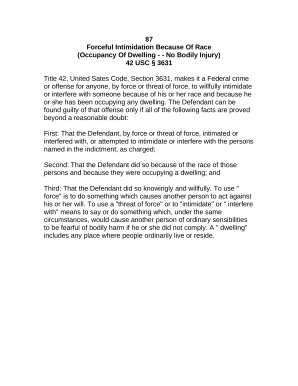
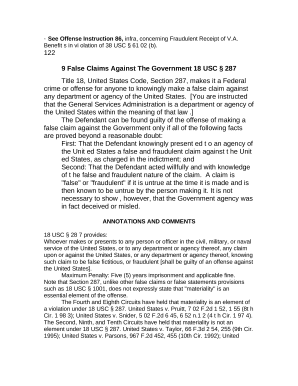
The judge will instruct the jury in each separate case as to the law of that case. For example, in each criminal case, the judge will tell the jury, among other things, that a defendant charged with a crime is presumed to be innocent and the burden of proving his guilt beyond a reasonable doubt is upon the Government.
Jury instructions are instructions for jury deliberation that are written by the judge and given to the jury. At trial, jury deliberation occurs after evidence is presented and closing arguments are made.
The full cite should be to Judicial Council of California Civil Jury Instructions (year). The short cite to particular instructions should be to CACI No. .
For jury instructions to be effective, they must be clear and simple. Sentences should be short; instruc- tions should contain no more than a few sentences, cover only one topic, and be directly related to the circumstances of the case (they should not be abstract statements of the law).
Either before or after the closing arguments by the lawyers, the judge will explain the law that applies to the case to you. This is the judges instruction to the jury. You have to apply that law to the facts, as you have heard them, in arriving at your verdict.
Jury instructions tell the jury what the laws are that govern a particular case. Each attorney gives the judge a set of proposed jury instructions. The judge considers each instruction and gives the one that properly states the law that applies to the case.
