


Create your New Hampshire Housing Law from scratch

Start Building Now
Title decoration

Here's how it works

01. Start with a blank New Hampshire Housing Law
Open the blank document in the editor, set the document view, and add extra pages if applicable.
02. Add and configure fillable fields
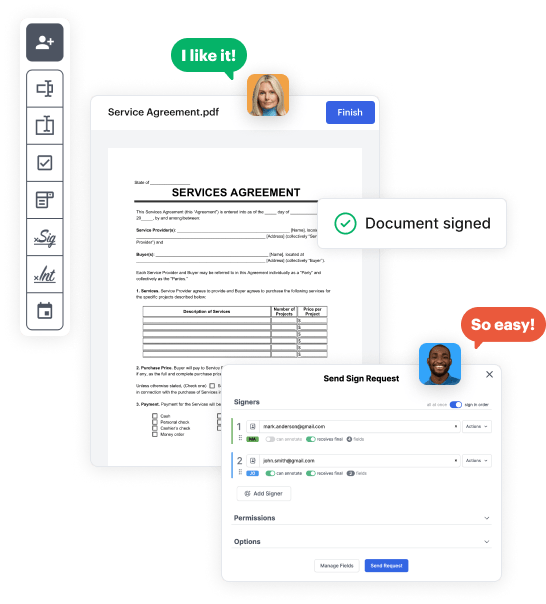
Use the top toolbar to insert fields like text and signature boxes, radio buttons, checkboxes, and more. Assign users to fields.
03. Distribute your form
Share your New Hampshire Housing Law in seconds via email or a link. You can also download it, export it, or print it out.

Create your New Hampshire Housing Law in a matter of minutes

Form edit decoration

Step 1: Access DocHub to build your New Hampshire Housing Law.

Start by logging into your DocHub account. Utilize the advanced DocHub functionality at no cost for 30 days.

Step 2: Navigate to the dashboard.

Once signed in, head to the DocHub dashboard. This is where you'll build your forms and handle your document workflow.

Step 3: Design the New Hampshire Housing Law.

Hit New Document and select Create Blank Document to be taken to the form builder.

Step 4: Set up the form layout.

Use the DocHub toolset to insert and arrange form fields like text areas, signature boxes, images, and others to your form.

Step 5: Add text and titles.

Add necessary text, such as questions or instructions, using the text field to lead the users in your form.

Step 6: Configure field properties.

Modify the properties of each field, such as making them compulsory or arranging them according to the data you plan to collect. Assign recipients if applicable.

Step 7: Review and save.

After you’ve managed to design the New Hampshire Housing Law, make a final review of your form. Then, save the form within DocHub, send it to your chosen location, or share it via a link or email.


be ready to get more

Build your New Hampshire Housing Law in minutes

Start creating now

Got questions?

We have answers to the most popular questions from our customers. If you can't find an answer to your question, please contact us.
Contact us
The New Hampshire law defines an ADU as a residential living unit that is within or attached to a single-family dwelling, and that provides independent living facilities for one or more persons, including provisions for sleeping, eating, cooking, and sanitation on the same parcel of land as the principal dwelling.
ADU minimum and maximum size may be spec- ified, but the municipality cannot require ADUs to be smaller than 750 s.f. The owner, however, may build a unit smaller than that, subject to local ADU unit size minimum, if any.
The state statute only requires municipalities to allow attached ADUs; it is up to local officials as to whether to allow detached ADUs.
Month-to-month tenant If you do not have a lease, the landlord can increase the rent, but must give written notice of the increase (or any other docHub change), 30 days in advance. Likewise, you can leave without continuing to owe rent as long as you give the landlord 30 days notice.
Specifically, New Hampshire landlords must ensure that the rental is habitable and fit for living, and that there are no defects that make the place unsafe or unsanitary. The implied warranty of habitability in New Hampshire protects tenants from structural defects in the rental. (Walls v.
be ready to get more

Build your New Hampshire Housing Law in minutes

Start creating now

Related Q&A to New Hampshire Housing Law

In 2008, the New Hampshire Legislature passed a law that requires every community to provide reasonable and realistic opportunities for the development of workforce housing. New Hampshires workforce housing statute (NH RSA 674: 58-61). The statute defines workforce housing and what is considered affordable.
On the flip side, local authorities can also adopt more restrictive policies on ADUs. All in all the maximum size for a granny flat is 1,200 sq. ft. or half the size of the existing residence. A detached ADU must be ten feet away from the main residence and five feet away from any property lines.
New Hampshire House Bill 1291. Bill Title: Relative to accessory dwelling unit uses allowed by right. AN ACT relative to accessory dwelling unit uses allowed by right. This bill increases the number of accessory dwelling units allowed by right from one to 2, adds definitions, and increases the maximum square footage.


