Enhance your document administration with Motion Forms in Criminal Law

Your workflows always benefit when you can easily obtain all of the forms and files you may need on hand. DocHub offers a a huge collection of document templates to relieve your day-to-day pains. Get a hold of Motion Forms in Criminal Law category and quickly find your document.

Begin working with Motion Forms in Criminal Law in a few clicks:

  1. Access Motion Forms in Criminal Law and find the document you require.
  2. Click Get Form to open it in our editor.
  3. Begin modifying your document: add more fillable fields, highlight paragraphs, or blackout sensitive facts.
  4. The application saves your modifications automatically, and after you are ready, you can download or distribute your form with other contributors.

Enjoy effortless document management with DocHub. Check out our Motion Forms in Criminal Law category and locate your form today!


Video Guide on Motion Forms in Criminal Law management

video background

Commonly Asked Questions about Motion Forms in Criminal Law

The Office of Judicial Administration implements the rules and policies of the Supreme Court as they apply to the operation and administration of the judicial branch.
Everyone has the right to file a case in federal court without an attorneys help. This is known as representing yourself or proceeding pro se. If you are representing yourself, the judge will still expect you to state your complaints clearly, to meet all of your deadlines, and follow the rules.
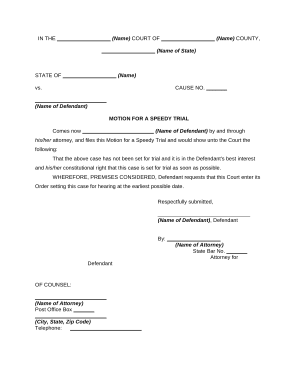
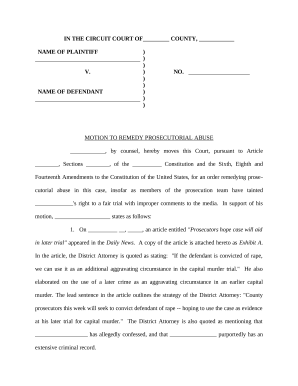
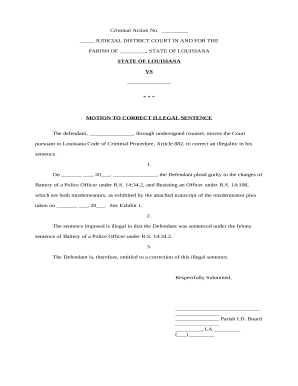
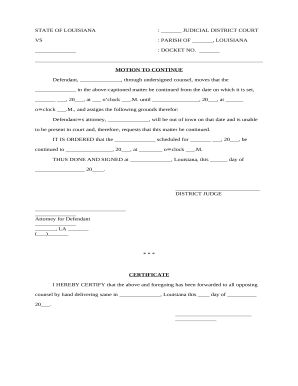
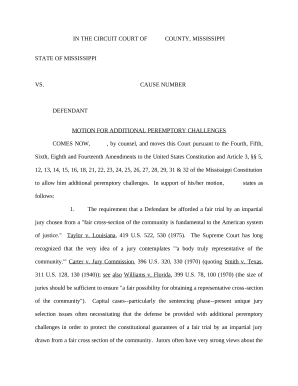
One of the last steps a prosecutor takes before trial is to respond to or file motions. A motion is an application to the court made by the prosecutor or defense attorney, requesting that the court make a decision on a certain issue before the trial begins.
Defending yourself in court is uncommon in our legal system, but there are instances where it does occur. The majority of people represent themselves in court for a variety of reasons.
Pro se actually means for himself, and in legal terms it means a person represents himself/herself in court when either filing an action or responding to an action without the assistance of an attorney. Pro se litigants are held to the same standard as attorneys.
: the act or an instance of representing oneself: such as. a. : an artistic likeness or image of oneself. Social media self-representations can be a site for creativity, showcasing photography, clothing ensembles, hair and make-up, making memes and so on.
It is a right the defendant must adopt knowingly and intelligently; under some circumstances the trial judge may deny the authority to exercise it, as when the defendant simply lacks the competence to make a knowing or intelligent waiver of counsel or when his self-representation is so disruptive of orderly procedures