Improve your template administration with Montana Real Estate Legal Documents

Your workflows always benefit when you are able to locate all of the forms and documents you need on hand. DocHub supplies a wide array of form templates to alleviate your day-to-day pains. Get hold of Montana Real Estate Legal Documents category and quickly find your form.

Begin working with Montana Real Estate Legal Documents in a few clicks:

  1. Browse Montana Real Estate Legal Documents and get the form you require.
  2. Click Get Form to open it in our editor.
  3. Begin modifying your file: add more fillable fields, highlight sentences, or blackout sensitive details.
  4. The app saves your adjustments automatically, and after you are all set, you are able to download or distribute your form with other contributors.

Enjoy smooth form managing with DocHub. Check out our Montana Real Estate Legal Documents collection and locate your form today!


Video Guide on Montana Real Estate Legal Documents management

video background

Commonly Asked Questions about Montana Real Estate Legal Documents

Reciprocity: None Montana does not offer reciprocity, but you may qualify for a Montana real estate license by following the Out-of-State Licensee/Waiver Process: The following documents and additional forms are required in addition to the basic application.
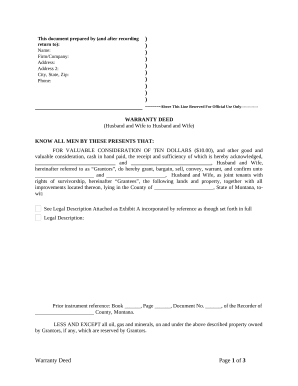
There are several different essentials to a valid deed: 1. It must be in writing; 2. The parties must be properly described; 3. The parties must be competent to convey and capable of receiving the grant of the property; 4.
The grantor must sign a quitclaim deed and acknowledge it before a notary public. The grantor then records the deed with the Clerk and Recorder in the county where the real property is located. Recording a quitclaim deed provides notice to all subsequent mortgagees and purchasers there is a new owner of the property.
A deed is a written document which is executed with the necessary formality (that is, more than a simple signature), and by which an interest, right or property passes or is confirmed, or an obligation binding on some person is created or confirmed. Deeds are generally enforceable despite any lack of consideration.
For a deed to be valid, it must contain several essential elements, including the operative words of conveyance, description of the property, signatures, delivery, proper formatting and execution, absence of defects and encumbrances, legal capacity of parties, proper recording, and voluntary execution.