

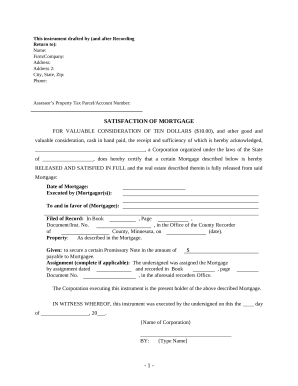
Transform your file operations with Minnesota State Legal Forms

Your workflows always benefit when you are able to get all of the forms and files you will need on hand. DocHub provides a a huge library of forms to alleviate your day-to-day pains. Get a hold of Minnesota State Legal Forms category and quickly find your form.

Begin working with Minnesota State Legal Forms in several clicks:

  1. Browse Minnesota State Legal Forms and discover the document you need.
  2. Click on Get Form to open it in the editor.
  3. Begin editing your document: add fillable fields, highlight paragraphs, or blackout sensitive info.
  4. The app saves your modifications automatically, and once you are all set, you can download or distribute your file with other contributors.

Enjoy effortless form managing with DocHub. Discover our Minnesota State Legal Forms category and locate your form today!


Video Guide on Minnesota State Legal Forms management

video background

Commonly Asked Questions about Minnesota State Legal Forms

You must file the original motion and supporting documents (attachments) and affidavit of service at the court location in which your case was initiated. You must pay a motion fee when filing these documents with the court. Please note that you must also pay the filing fee if it has not been previously paid.
Whats a Motion Hearing? A motion hearing in family court is different from a trial. In motion hearings, parties attorneys submit documents to the court before the hearing explaining what their side wants and why it should be granted. Except in special circumstances, witnesses do not testify in motion hearings.
State Court: the moving partys motion and supporting documents are due at least 28 days before the hearing; the opposing partys response is due at least 14 days before the hearing; and moving party may submit a reply memorandum, limited to new legal or factual matters raised by an opposing partys response to a
Pursuant to Minnesota Rules of Criminal Procedure (20.01 and 20.02), Rule 20 evaluations occur in criminal cases when there is a belief that a defendant may not be competent to proceed with the case or was not responsible at the time of the alleged offense because of mental illness or developmental disability.
A motion to quash a warrant is a request for the court to effectively get rid of the warrant and set a court date. The court may refer quashing the warrant as recalling the warrant.
Affidavit of No-Probate (PS2071) is used by one or more heirs at law (adult children, parents, siblings), who affirm they have the authority to represent all heirs and that the estate is not subject to probate.
Options for service: (1) The sheriff (for a fee), (2) A private process server (for a fee) or (3) A third party (who is at least 18 years of age). Once service is done, make sure the sheriff/process server/third party gives you the Affidavit of Service. File the Affidavit of Service with Court Administration.
