Raise your production with Minnesota Court Order Forms

Document administration occupies to half of your office hours. With DocHub, you can reclaim your time and effort and improve your team's efficiency. Access Minnesota Court Order Forms collection and explore all document templates related to your daily workflows.

The best way to use Minnesota Court Order Forms:

  1. Open Minnesota Court Order Forms and use Preview to obtain the appropriate form.
  2. Click Get Form to start working on it.
  3. Wait for your form to upload in the online editor and begin editing it.
  4. Add new fillable fields, icons, and pictures, adjust pages, and many more.
  5. Fill out your file or set it for other contributors.
  6. Download or deliver the form by link, email attachment, or invite.

Speed up your daily document administration with the Minnesota Court Order Forms. Get your free DocHub profile right now to explore all templates.


Video Guide on Minnesota Court Order Forms management

video background

Commonly Asked Questions about Minnesota Court Order Forms

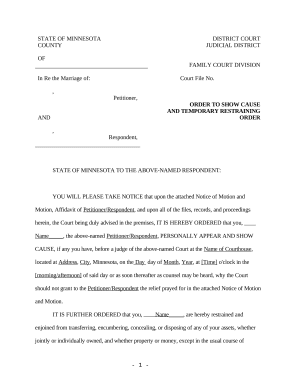
An order to show cause is good to use in an emergency situation. It can often get you into court faster than a motion. It can ask the court for immediate help until the case is back in court, such as stopping a sale of a home, or the taking of money out of your bank account.
A notice to show cause is a formal document issued to one party in a dispute. It sets out details of an alleged offence or misconduct. In doing so, the receiving party will have the chance to explain themselves or otherwise face some further consequences.
An order to show cause is a type of court order that requires one or more of the parties to a case to justify, explain, or prove something to the court. Courts commonly use orders to show cause when the judge needs more information before deciding whether or not to issue an order requested by one of the parties.
An order to show cause will be issued only in a case where a statute or rule of civil procedure provides that such an order may be issued or where the court deems it necessary to require the party to appear in person at the hearing. Cross Reference: Minn.
A judge or judicial officer who has presided at a motion or other proceeding or who is assigned by the Chief Justice of the Minnesota Supreme Court may not be removed except upon an affirmative showing that the judge or judicial officer is disqualified under the Code of Judicial Conduct.
A motion to quash a warrant is a request for the court to effectively get rid of the warrant and set a court date. The court may refer quashing the warrant as recalling the warrant.
To enforce a judgment that was not paid during the 10 year timeframe, the judgment creditor has to renew the judgment by starting a new lawsuit before the end of the 10 year period, based on a claim for failure to pay a judgment. See Minn. Stat.
Rule 303.01 imposes a simple burden on any party, whether or not represented by counsel: to promptly advise the other parties when a hearing date is obtained from the court.