

Handle Masonry Contract Forms easily online

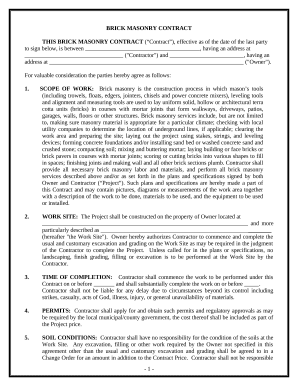
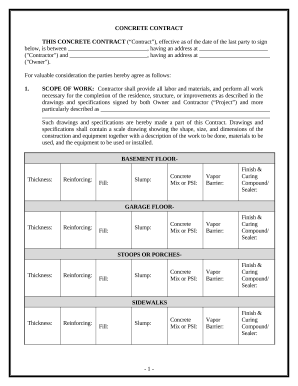
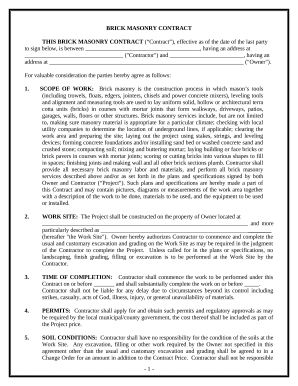
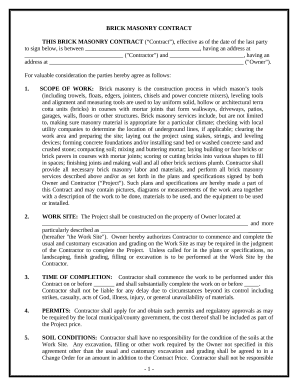
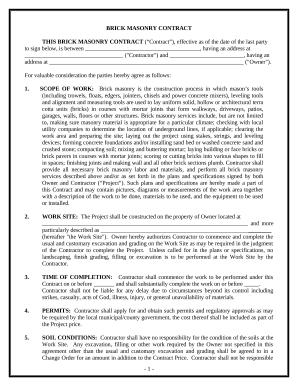
Document managing can overwhelm you when you can’t locate all the documents you need. Fortunately, with DocHub's substantial form library, you can find all you need and quickly deal with it without the need of changing between applications. Get our Masonry Contract Forms and start working with them.

How to use our Masonry Contract Forms using these easy steps:

  1. Examine Masonry Contract Forms and select the form you need.
  2. Review the template and click Get Form.
  3. Wait for it to open in our online editor.
  4. Change your document: include new information and images, and fillable fields or blackout some parts if necessary.
  5. Complete your document, preserve changes, and prepare it for delivering.
  6. When you are ready, download your form or share it with other contributors.

Try out DocHub and browse our Masonry Contract Forms category easily. Get a free account today!

Video Guide on Masonry Contract Forms management

video background

Commonly Asked Questions about Masonry Contract Forms

Quite simply masonry moves, it will expand and contract depending on moisture, temperature and other factors. If you leave this unaddressed it will have a catastrophic effect on a buildings appearance, function and longevity.
Contract Types Comparison Party 1 offers Bilateral Services or goods that are of value to the other party Unilateral Services or goods that the other party requested, usually in an open request Implied Services or goods Express Anything9 more rows Jan 26, 2022
The basic elements required for the agreement to be a legally enforceable contract are: mutual assent, expressed by a valid offer and acceptance; adequate consideration; capacity; and legality.
Lump sum contracts This is the most basic and common type of construction contract. Lump sum contracts work especially well for projects with a well-defined scope of work, which enables contractors to make an accurate estimate of the projects cost.
Here are four main construction contracts to choose from, plus their pros and cons: Lump-Sum Contracts. Cost-Plus-Fee Contracts. Guaranteed Maximum Price Contracts. Unit-Price Contracts.
There are five common types of construction contracts: lump sum (or fixed price), time and materials (TM), unit price, guaranteed maximum price (GMP), and cost-plus.
How to draft a contract between two parties: A step-by-step checklist Know your parties. Agree on the terms. Set clear boundaries. Spell out the consequences. Specify how you will resolve disputes. Cover confidentiality. Check the legality of the contract. Open it up to negotiation.
Basic types of construction The four main types of construction are: residential construction, commercial construction, industrial construction, and infrastructure construction.

