
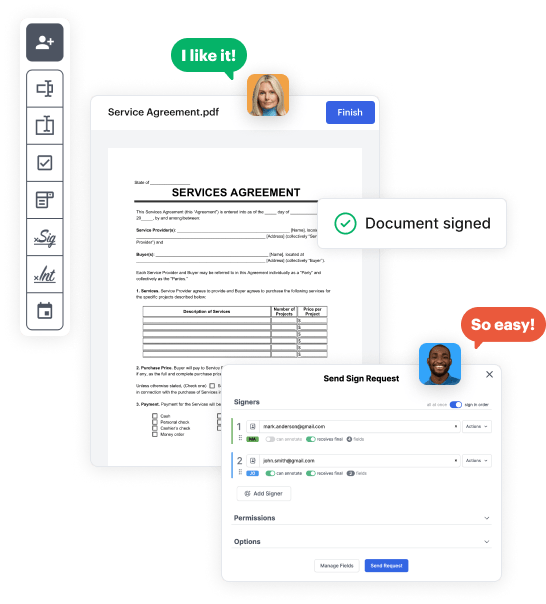
Create your Marital Property Settlement from scratch

Start Building Now
Title decoration

Here's how it works

01. Start with a blank Marital Property Settlement
Open the blank document in the editor, set the document view, and add extra pages if applicable.
02. Add and configure fillable fields
Use the top toolbar to insert fields like text and signature boxes, radio buttons, checkboxes, and more. Assign users to fields.
03. Distribute your form
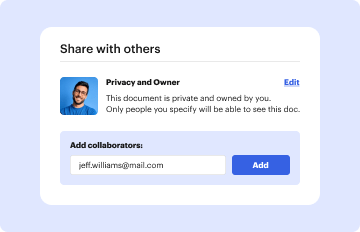
Share your Marital Property Settlement in seconds via email or a link. You can also download it, export it, or print it out.

Build Marital Property Settlement from the ground up by following these comprehensive instructions

Form edit decoration

Step 1: Get started with DocHub.

Start by registering a free DocHub account using any available sign-up method. If you already have one, simply log in.

Step 2: Register for a 30-day free trial.

Try out the whole collection of DocHub's advanced features by signing up for a free 30-day trial of the Pro plan and proceed to build your Marital Property Settlement.

Step 3: Build a new empty form.

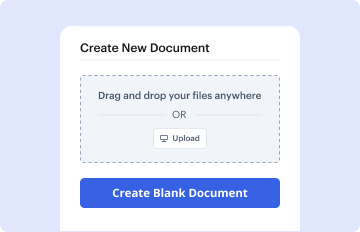
In your dashboard, click the New Document button > scroll down and hit Create Blank Document. You’ll be taken to the editor.

Step 4: Organize the document’s view.

Use the Page Controls icon marked by the arrow to switch between two page views and layouts for more flexibility.

Step 5: Begin by adding fields to design the dynamic Marital Property Settlement.

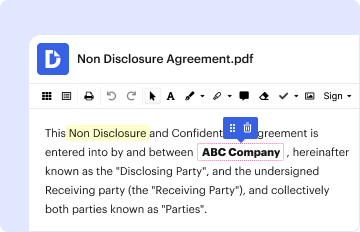
Explore the top toolbar to place document fields. Insert and arrange text boxes, the signature block (if applicable), insert images, etc.

Step 6: Prepare and customize the added fields.

Arrange the fields you added per your preferred layout. Modify each field's size, font, and alignment to ensure the form is user-friendly and neat-looking.

Step 7: Finalize and share your document.

Save the completed copy in DocHub or in platforms like Google Drive or Dropbox, or create a new Marital Property Settlement. Share your form via email or utilize a public link to reach more people.


be ready to get more

Build your Marital Property Settlement in minutes

Start creating now

Got questions?

We have answers to the most popular questions from our customers. If you can't find an answer to your question, please contact us.
Contact us
If you acquired a piece of property (such as your parents vacation home) in your name only before marriage, it might still be considered yours solely. However, it could become community property if your spouse has a docHub connection to the property, such as making repairs or helping to pay the taxes.
For long-term marriages (over 25 years), the court will usually try to put both parties in an equal financial position for either the remainder of their lives or until both parties retire. The idea is that after 25 years, the parties should be recognized as financially equal partners.
Courts usually award each spouse his or her separate property and divide community property 50/50. Consequently, if the house is entirely one spouses separate property, he or she almost always receives it unless the parties agree otherwise.
A court in Washington State will usually a) award each party his or her own separate property and b) divide the net value of the parties community property 50/50. This means the husband keeps what he brought to the marriage, the wife keeps what she brought, and the rest gets split between them equally.
Generally, separate property is: Anything you earned or owned (or a debt) from before you married or after you separated. Anything you buy with separate property or you earn from separate property. Gifts or inheritance (to one of you) even if it was given or inherited when you were married.
be ready to get more

Build your Marital Property Settlement in minutes

Start creating now

Related Q&A to Marital Property Settlement

The Definition of Separate Property Under California Family Code. California Family Code 770 provides that separate property includes: Property owned before marriage. Property acquired after marriage by gift, bequest, devise, or descent Income derived from the above, including rents and profits.
In California, divorce modification is possible, but only certain parts of the divorce decree can be changed. The basis for seeking divorce modification in the state are usually limited, making it essential to think about the divorce process and approach it with great caution.
In some cases, separate property can transform into marital property during the course of a marriage. This transformation typically occurs due to commingling of assets, transmutation through title change, or the appreciation of separate property during the marriage.
There are three types of separation: trial separation, permanent separation, and legal separation. While legal separation must be approved by a family court and may serve as an alternative to divorce, trial and permanent separation are more immediate measures taken before a divorce or potential divorce.
Separate property is defined as property owned before marriage and property acquired during the marriage by gift, bequest, devise, descent, or inheritance, including any profits arising from that separate property. RCW 26.16.

Additional resources on building your forms


