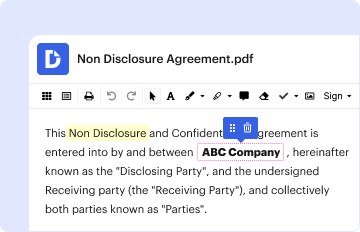
Create your Louisiana Law Form from scratch

Start Building Now
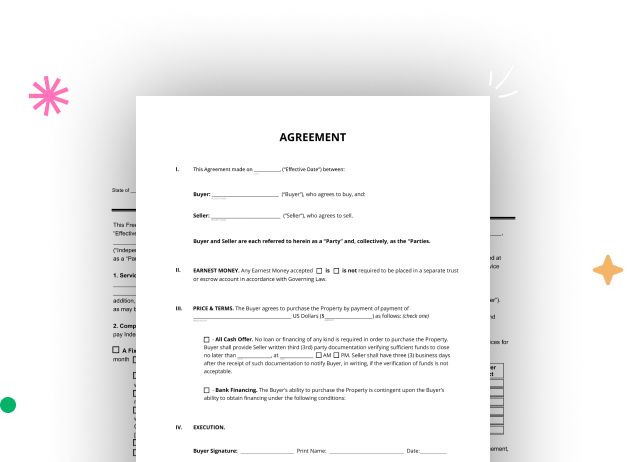
Title decoration

Here's how it works

01. Start with a blank Louisiana Law Form
Open the blank document in the editor, set the document view, and add extra pages if applicable.
02. Add and configure fillable fields
Use the top toolbar to insert fields like text and signature boxes, radio buttons, checkboxes, and more. Assign users to fields.
03. Distribute your form
Share your Louisiana Law Form in seconds via email or a link. You can also download it, export it, or print it out.

A detailed guide on how to design your Louisiana Law Form online
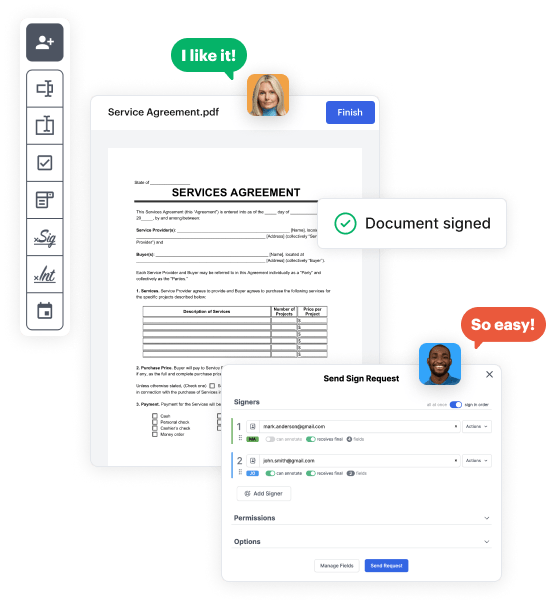
Form edit decoration

Step 1: Start with DocHub's free trial.

Navigate to the DocHub website and register for the free trial. This provides access to every feature you’ll need to create your Louisiana Law Form without any upfront cost.

Step 2: Access your dashboard.

Sign in to your DocHub account and navigate to the dashboard.

Step 3: Initiate a new document.

Click New Document in your dashboard, and choose Create Blank Document to create your Louisiana Law Form from the ground up.

Step 4: Use editing tools.

Add various fields such as text boxes, radio buttons, icons, signatures, etc. Arrange these elements to suit the layout of your form and assign them to recipients if needed.

Step 5: Organize the form layout.

Rearrange your form in seconds by adding, moving, deleting, or merging pages with just a few clicks.

Step 6: Set up the Louisiana Law Form template.

Turn your newly crafted form into a template if you need to send many copies of the same document multiple times.

Step 7: Save, export, or share the form.

Send the form via email, share a public link, or even publish it online if you wish to collect responses from a broader audience.


be ready to get more

Build your Louisiana Law Form in minutes

Start creating now

Got questions?

We have answers to the most popular questions from our customers. If you can't find an answer to your question, please contact us.
Contact us
People who represent themselves in court without an attorney are Self-Represented Litigants (SRLs), also sometimes called pro se litigants. Under the law, an SRL is held to the same standards and duties as an attorney admitted to the practice of law in the state of Louisiana.
Websters New Collegiate Dictionary gives two definitions that are particularly useful to legal researchers: a prescribed order and set of words and a printed or typed document with blank spaces for insertion of required or requested information. Both kinds of forms are available through the Goodson Law Library,
When you represent yourself, you are referred to as a self-represented litigant or pro-se litigant. Even if you dont have a lawyer, judges and court employees are not allowed to provide you with legal advice and may not be able to speak with you at all about your case outside of the courtroom.
Definitions. Self-Represented Litigant: A person (party) who advocates on his or her own behalf before a court, rather than being represented by an attorney. These litigants are also known as pro se or pro per litigants. Cases with Self-Represented Litigants: Legal cases in which one or more parties is self-represented
Risks of representing yourself The biggest risk is that you lose your case because (1) you are unable to follow all the required procedures to bring your case to trial so your case is dismissed, or (2) once you get to trial, you cannot meet all the technical requirements to prove your case.
be ready to get more

Build your Louisiana Law Form in minutes

Start creating now

Related Q&A to Louisiana Law Form

Process: The will is usually typed or printed. The testator signs the will in front of the notary and the two witnesses. The witnesses also sign. The notary verifies the signatures and ensures all legal formalities get followed. Learn more about finding a notary in the state of Louisiana.
Yes, Louisiana law is different from common law. The difference between Common Law and Louisiana Law, quite simply, is how judges make decisions about cases. In Common Law, judges are bound by precedent; in Louisiana law, they rely on the Civil Code, most of the time.
Pro se actually means for himself, and in legal terms it means a person represents himself/herself in court when either filing an action or responding to an action without the assistance of an attorney. Pro se litigants are held to the same standard as attorneys.

Additional resources on building your forms