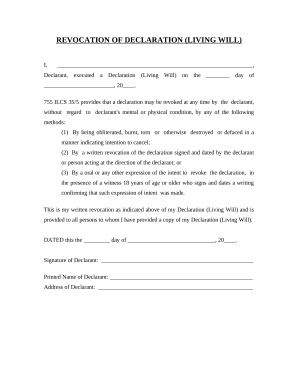
Improve your template administration with Living Will Revocation Forms

Your workflows always benefit when you can discover all the forms and files you may need on hand. DocHub offers a wide array of templates to relieve your daily pains. Get hold of Living Will Revocation Forms category and quickly browse for your document.

Begin working with Living Will Revocation Forms in a few clicks:

  1. Access Living Will Revocation Forms and get the form you need.
  2. Click Get Form to open it in the editor.
  3. Begin adjusting your file: add fillable fields, highlight paragraphs, or blackout sensitive details.
  4. The application saves your changes automatically, and once you are all set, you are able to download or distribute your form with other contributors.

Enjoy smooth form management with DocHub. Explore our Living Will Revocation Forms collection and find your form right now!


Video Guide on Living Will Revocation Forms management

video background

Commonly Asked Questions about Living Will Revocation Forms

There are three main ways to revoke a will: Make a new will, following all the rules for creating and signing a valid will, as long as you still have the mental capacity to create a new will. Write something that clearly shows that you want to revoke your will. Physically destroy the will. Change A Will - Codicil | NYC Bar New York City Bar Association Wills New York City Bar Association Wills
How to Update or Revoke Your Will Executing a New Will. The most obvious way to change a will is to simply create a new one. Codicil. Whereas a new will replaces old ones, a codicil merely updates a current will. Personal Property Memorandum.
You may wish to revoke your power of attorney in the following circumstances: After your agent passes away. You no longer trust your agent. The individual can no longer act as your agent or does not want the responsibility.
Revoking a will by operation of law is not an action you carry out on your own; it happens automatically when certain events such as divorce, annulment or marriage take place. It is important to research your state laws to learn the impact marriages and divorces have on your will, as laws vary from state to state. What Voids a Will? | Steps for How to Revoke a Will Keystone Law Group Keystone Law what-voids-a-will Keystone Law what-voids-a-will
Frequently acceptable acts to demonstrate revocation include burning, tearing, canceling, obliterating, or destroying the will. Revocation by act can usually be carried out by the testator or a person acting at the direction of the testator.
Costs for the removal of an Executer from a will can be anywhere between 5,000 and 15,000 plus VAT. As noted before, the more complicated the case, the more expensive the court fees will be. If there are evidential issues, costs can docHub heights of 20,000 and even 30,000 plus VAT. Disinheritance: A Guide to Cutting Someone from Your Will thelawsuperstore.co.uk help-and-advice thelawsuperstore.co.uk help-and-advice
The revocation clause revokes all of the wills and codicils that you (the testator) have made in the past. The purpose of the revocation clause is to prevent any of your earlier wills and codicils from having any legal effect after your new simple will is executed. Revocation Clause - Washington Wills Washington Wills will-drafting-instructions revocat Washington Wills will-drafting-instructions revocat
Codicil: A supplement or an addition to a will; it may explain, modify, add to, subtract from, qualify, alter or revoke provisions of an existing will. Revival: A will may be revived if the testator revokes the will he no longer wants to be his will and republishes the old will either by re-execution or by codicil. Foundations of Law - Republications and Codicils - LawShelf LawShelf coursewarecontentview rep LawShelf coursewarecontentview rep
Types of Revocation Intentional revocation. Revocation by operation of law. Mutual cancellation by both parties.