
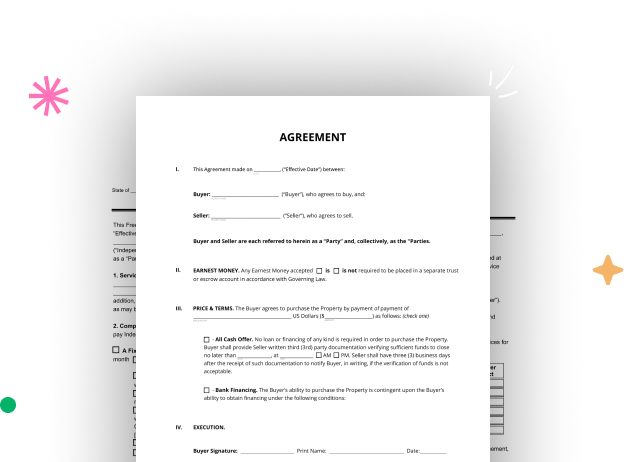

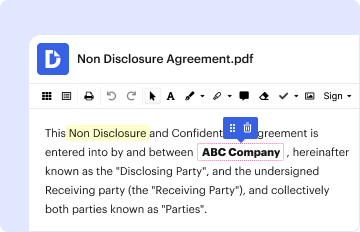


Create your Legal Malpractice Form from scratch

Start Building Now
Title decoration

Here's how it works

01. Start with a blank Legal Malpractice Form
Open the blank document in the editor, set the document view, and add extra pages if applicable.
02. Add and configure fillable fields
Use the top toolbar to insert fields like text and signature boxes, radio buttons, checkboxes, and more. Assign users to fields.
03. Distribute your form
Share your Legal Malpractice Form in seconds via email or a link. You can also download it, export it, or print it out.

A detailed guide on how to build your Legal Malpractice Form online

Form edit decoration

Step 1: Start with DocHub's free trial.

Visit the DocHub website and sign up for the free trial. This gives you access to every feature you’ll require to create your Legal Malpractice Form with no upfront cost.

Step 2: Access your dashboard.

Sign in to your DocHub account and go to the dashboard.

Step 3: Initiate a new document.

Click New Document in your dashboard, and select Create Blank Document to create your Legal Malpractice Form from scratch.

Step 4: Utilize editing tools.

Add various fields such as text boxes, radio buttons, icons, signatures, etc. Arrange these fields to match the layout of your form and designate them to recipients if needed.

Step 5: Modify the form layout.

Organize your form in seconds by adding, moving, deleting, or combining pages with just a few clicks.

Step 6: Craft the Legal Malpractice Form template.

Convert your newly designed form into a template if you need to send many copies of the same document repeatedly.

Step 7: Save, export, or share the form.

Send the form via email, share a public link, or even publish it online if you wish to collect responses from more recipients.


be ready to get more

Build your Legal Malpractice Form in minutes

Start creating now

Got questions?

We have answers to the most popular questions from our customers. If you can't find an answer to your question, please contact us.
Contact us
Duty: The duty of care owed to patients. Dereliction: Or bdocHub of this duty of care. Direct cause: Establishing that the bdocHub caused injury to a patient. Damages: The economic and noneconomic losses suffered by the patient as a result of their injury or illness.
Failure To Treat This includes discharging a patient too soon, not providing the correct follow-up care, or not providing the standard of care required for their specific condition. All of these constitute medical malpractice.
How to Write a Settlement Demand Letter An account of the event that injured you. A description of your injuries. List all the medical treatments you had. Explanation of whos responsible for your injury, and why. List of damages. Make your demand.
To prove legal malpractice, a plaintiff must show: There was an attorney-client relationship (with rare exceptions); The attorney was negligent (bdocHubed the duty of care); The negligence caused plaintiffs injury; and. The injury caused actual damages.
To do so, four legal elements must be proven: (1) a professional duty owed to the patient; (2) bdocHub of such duty; (3) injury caused by the bdocHub; and (4) resulting damages.
be ready to get more

Build your Legal Malpractice Form in minutes

Start creating now

Related Q&A to Legal Malpractice Form

To prove legal malpractice you must establish the following four elements: (1) duty, (2) bdocHub, (3) causation, and (4) harm. These are the basic elements for most torts in California. Duty. A plaintiff must show the existence of an agreement, either express or implied, that creates an attorney-client relationship.
ing to the National Center for Biotechnology Information (NCBI), the four elements of a medical malpractice case include: The professional duty of care owed to the patient. The bdocHub of this duty of care. The causal link between the bdocHub of duty and the injuries. The resulting damages from the event.
Rule: There are three necessary elements for a plaintiff to prove a legal malpractice case in New York: (1) negligence, (2) proximate cause, and (3) damages. caused plaintiff to sustain actual and ascertainable damages (Rudolf v. Shayne, Dachs, Stanisci, Corker Sauer, 8 N.Y.

Additional resources on building your forms


