Supercharge your output with Legal Interrogatories

Form managing occupies to half of your business hours. With DocHub, it is easy to reclaim your time and effort and increase your team's efficiency. Access Legal Interrogatories category and discover all document templates related to your everyday workflows.

Easily use Legal Interrogatories:

  1. Open Legal Interrogatories and utilize Preview to obtain the appropriate form.
  2. Click Get Form to begin working on it.
  3. Wait for your form to open in the online editor and start modifying it.
  4. Add new fillable fields, symbols, and images, adjust pages, etc.
  5. Fill out your document or set it for other contributors.
  6. Download or deliver the form by link, email attachment, or invite.

Accelerate your everyday document managing using our Legal Interrogatories. Get your free DocHub account right now to explore all templates.


Video Guide on Legal Interrogatories management

video background

Commonly Asked Questions about Legal Interrogatories

Interrogatories can also be used to obtain information about the parties involved in the dispute, the events that led up to the dispute, and what each party knows about the other partys position. Discovery is a process by which each party to a lawsuit collects evidence and information to support their case.
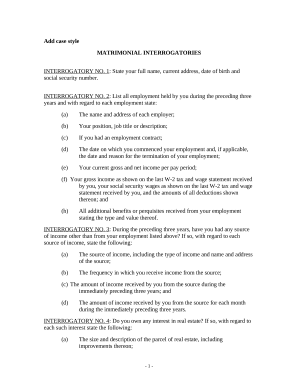
Interrogatories are written questions sent by one party in a lawsuit to another party in that same suit, which the responding party must answer under penalty of perjury. Interrogatories allow the parties to ask who, what, when, where and why questions, making them a good method for obtaining new information.
You have to respond to interrogatories in writing to the best of your ability. If you do not answer an interrogatory question, and then the other side learns that you did in fact know the answer, it could have a negative impact on your case at trial.
In civil procedure, an interrogatory is a list of written questions one party sends to another as part of the discovery process. The recipient must answer in writing under oath and ing to the cases schedule.
Can You Refuse Discovery In Any Instances? The Interrogatory Is Vague, Overly Broad, and Unduly Burdensome. The Request Is Irrelevant or Not Pertinent to the Matter at Hand. The Information Is Public and Available to Everyone. The Interrogatory Forces a Conclusion. A Violation of AttorneyClient Privilege.
Interrogatories may also be useful to define what an adversarys claims or defenses are. To that end, a party may ask an opponent to identify each fact that supports its claims or each instance of misconduct that it alleges.
Interrogatories are a discovery tool that the parties can use to have specific questions about a case answered before trial. Interrogatories are lists of questions sent to the other party that s/he must respond to in writing.
Interrogatories are lists of questions sent to the other party that s/he must respond to in writing. You can use interrogatories to find out facts about a case but they cannot be used for questions that draw a legal conclusion.
The most common discovery objection our lawyers see is the objection that the interrogatories are not relevant to the litigation or are too burdensome to answer. Another objection our attorneys see frequently because we asked detailed questions that pin down defendants is that the request calls for a legal conclusion. Cheat Sheet for Interrogatory and Discovery Objections millerandzois.com sample-interrogatories millerandzois.com sample-interrogatories