
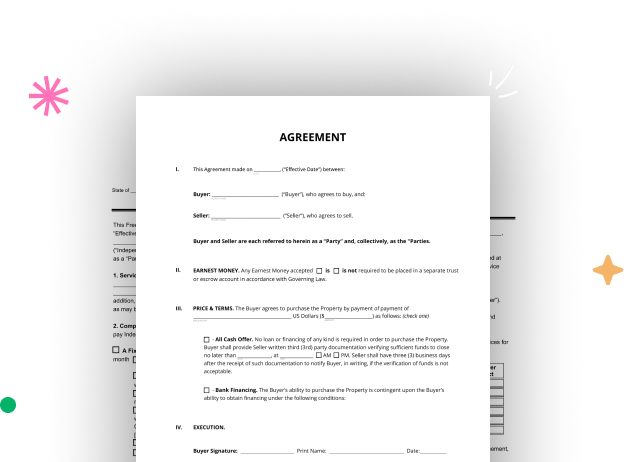
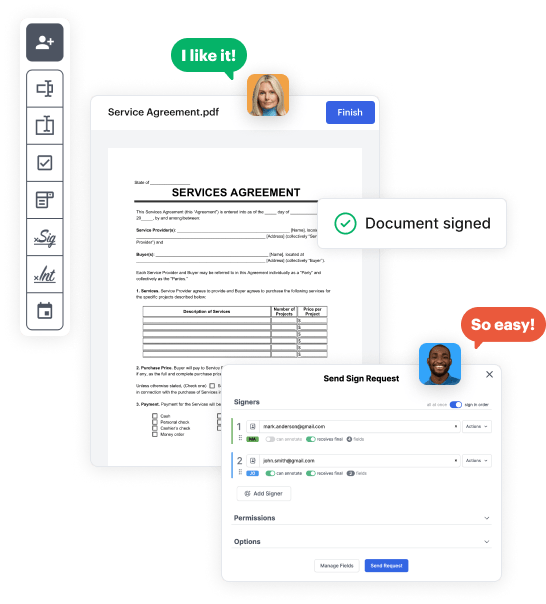
Create your Legal Finance Document from scratch

Start Building Now
Title decoration

Here's how it works

01. Start with a blank Legal Finance Document
Open the blank document in the editor, set the document view, and add extra pages if applicable.
02. Add and configure fillable fields
Use the top toolbar to insert fields like text and signature boxes, radio buttons, checkboxes, and more. Assign users to fields.
03. Distribute your form
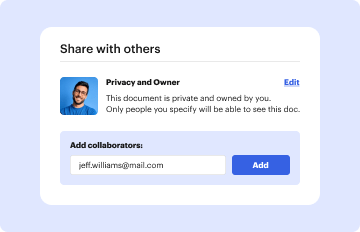
Share your Legal Finance Document in seconds via email or a link. You can also download it, export it, or print it out.

Design your Legal Finance Document in a matter of minutes

Form edit decoration

Step 1: Access DocHub to build your Legal Finance Document.

Start by logging into your DocHub account. Try out the advanced DocHub functionality free for 30 days.

Step 2: Go to the dashboard.

Once logged in, head to the DocHub dashboard. This is where you'll create your forms and handle your document workflow.

Step 3: Design the Legal Finance Document.

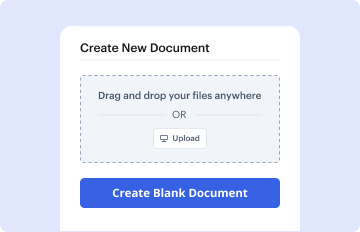
Hit New Document and select Create Blank Document to be taken to the form builder.

Step 4: Design the form layout.

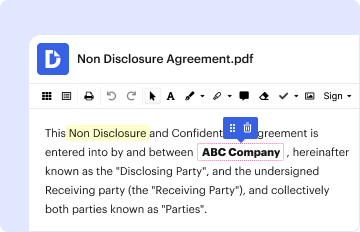
Use the DocHub features to insert and configure form fields like text areas, signature boxes, images, and others to your form.

Step 5: Add text and titles.

Add necessary text, such as questions or instructions, using the text tool to lead the users in your document.

Step 6: Configure field properties.

Alter the properties of each field, such as making them required or formatting them according to the data you expect to collect. Designate recipients if applicable.

Step 7: Review and save.

After you’ve managed to design the Legal Finance Document, make a final review of your form. Then, save the form within DocHub, transfer it to your chosen location, or distribute it via a link or email.


be ready to get more

Build your Legal Finance Document in minutes

Start creating now

Got questions?

We have answers to the most popular questions from our customers. If you can't find an answer to your question, please contact us.
Contact us
Why You Need a Business Contract Lawyer. If youre asking whether you need a lawyer to draft a contract, legally, the answer is no. Anyone can draft a contract on their own and as long as the elements above are included and both parties are legally competent and consent to the agreement, it is generally lawful.
To be legally valid, a contract must fulfill four basic requirements: All signees must be above the age of consent. All parties must agree to the contract freely. All parties must be able to understand the agreement (legal capacity) The terms of the agreement must be permitted in law.
Important points to include in a legal document. Party details. List the names, numbers, addresses (email or physical), and any other relevant information of all parties involved. Background information. Motion. Roles and responsibilities. BdocHubes or contingencies. Dates and signatures.
How to Format a Legal Document in Word Resize Your Document. Pick Your Fonts. Set the Line Spacing. Format Your Columns. Set Up Your Table of Contents. Create Your Table of Authorities. Automating Your Formatting. Creating a Style. Setting Up Autoformatting as You Type. A Note on Different Documents. Pleadings. Briefs. Manuscripts.
While its technically possible to write a demand letter yourself, there are docHub advantages to seeking the guidance of a legal professional. Heres why. Professional expertise. An attorney specialized in personal injury law understands the nuances of relevant statutes, case law, and procedural requirements.
be ready to get more

Build your Legal Finance Document in minutes

Start creating now

Related Q&A to Legal Finance Document

To be considered legally valid, a contract must meet certain criteria, such as mutual assent, consideration, capacity, and a legal purpose. However, it is possible to create a legal contract without hiring a lawyer. Seeking lawyers is customary but not necessary.
You may use a Payment Agreement to document money that is owed to you or money that you owe to someone else. It specifies the amount of the loan, the interest rate, the repayment terms and includes other specific provisions.

Additional resources on building your forms


