
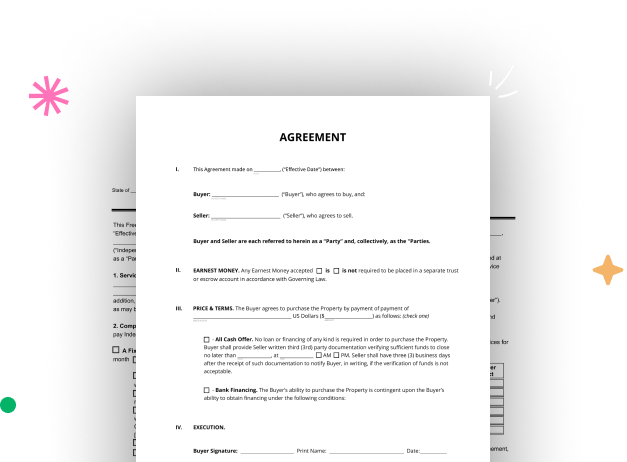

Create your Legal Deed Transfer Form from scratch

Start Building Now
Title decoration

Here's how it works

01. Start with a blank Legal Deed Transfer Form
Open the blank document in the editor, set the document view, and add extra pages if applicable.
02. Add and configure fillable fields
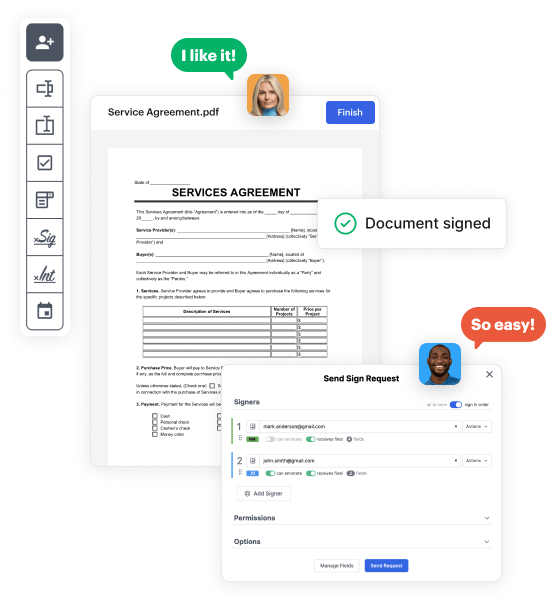
Use the top toolbar to insert fields like text and signature boxes, radio buttons, checkboxes, and more. Assign users to fields.
03. Distribute your form
Share your Legal Deed Transfer Form in seconds via email or a link. You can also download it, export it, or print it out.

Craft Legal Deed Transfer Form from the ground up with these detailed instructions

Form edit decoration

Step 1: Start off by launching DocHub.

Start by signing up for a free DocHub account using any available sign-up method. Simply log in if you already have one.

Step 2: Sign up for a 30-day free trial.

Try out the complete suite of DocHub's advanced tools by registering for a free 30-day trial of the Pro plan and proceed to build your Legal Deed Transfer Form.

Step 3: Add a new blank document.

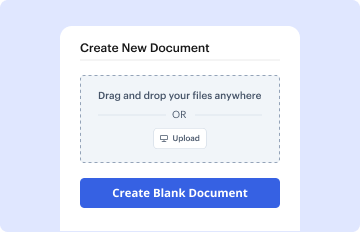
In your dashboard, select the New Document button > scroll down and choose to Create Blank Document. You will be taken to the editor.

Step 4: Arrange the view of the document.

Use the Page Controls icon indicated by the arrow to toggle between different page views and layouts for more flexibility.

Step 5: Begin by adding fields to design the dynamic Legal Deed Transfer Form.

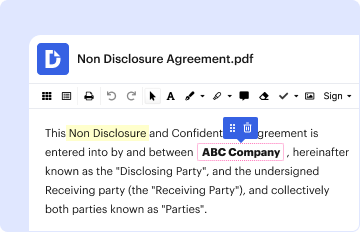
Explore the top toolbar to place document fields. Add and format text boxes, the signature block (if applicable), insert images, etc.

Step 6: Prepare and customize the added fields.

Configure the fields you added per your desired layout. Adjust the size, font, and alignment to make sure the form is straightforward and neat-looking.

Step 7: Finalize and share your document.

Save the completed copy in DocHub or in platforms like Google Drive or Dropbox, or design a new Legal Deed Transfer Form. Share your form via email or utilize a public link to reach more people.


be ready to get more

Build your Legal Deed Transfer Form in minutes

Start creating now

Got questions?

We have answers to the most popular questions from our customers. If you can't find an answer to your question, please contact us.
Contact us
The filing fee is generally $125 for residential and farm properties and $250 for all other properties. The county clerks office collects the RP-5217 filing fee. The county clerks office should be reviewing the RP-5217 forms for completeness, not for accuracy.
A New York deed must be filed with a Real Property Transfer Report (Form RP-5217). Form RP-5217 documents the details of the real estate transfer. The current owner and new owner must both sign the completed form.
The New York State transfer tax is 0.4% for properties below $3,000,000 and 0.65% for those $3,000,000 and up. The New York City transfer tax is 1% for properties below $500,000 and 1.425% for those $500,000 and up. The transfer tax is based on the purchase price of the property.
Sellers pay a combined NYC NYS Transfer Tax rate of 2.075% for sale prices of $3 million or more, 1.825% for sale prices above $500k and below $3 million, and 1.4% for sale prices of $500k or less.
To change a deed in New York City, you will need a deed signed and docHubd by the grantor. The deed must also be filed and recorded with the Office of the City Register. Transfer documents identifying if any taxes are due must also be filed and recorded with the City Register.
be ready to get more

Build your Legal Deed Transfer Form in minutes

Start creating now

Related Q&A to Legal Deed Transfer Form

A: An unrecorded deed is still valid and should be recorded asap, as NYS is a race state meaning of two valid deeds, the first filed has priority even if the other was more recent. Upon the death of one joint tenant, the survivor automatically obtains full ownership.
The fees involved in filing a quitclaim deed depend on the type of real estate being transferred. Filing a deed for a farm or residential property typically costs $125 and $250 for other types of property. There may be additional fees involved when filing your forms.

Additional resources on building your forms