Supercharge your work productivity with Lease Guaranty

Record managing takes up to half of your business hours. With DocHub, you can easily reclaim your office time and boost your team's efficiency. Access Lease Guaranty collection and explore all templates related to your daily workflows.

Effortlessly use Lease Guaranty:

  1. Open Lease Guaranty and apply Preview to find the suitable form.
  2. Click on Get Form to begin working on it.
  3. Wait for your form to open in the online editor and start editing it.
  4. Add new fillable fields, icons, and pictures, change pages order, and many more.
  5. Complete your document or prepare it for other contributors.
  6. Download or share the form by link, email attachment, or invite.

Boost your daily document managing with the Lease Guaranty. Get your free DocHub account right now to explore all forms.

Video Guide on Lease Guaranty management

video background

Commonly Asked Questions about Lease Guaranty

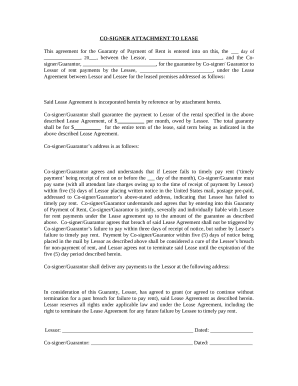
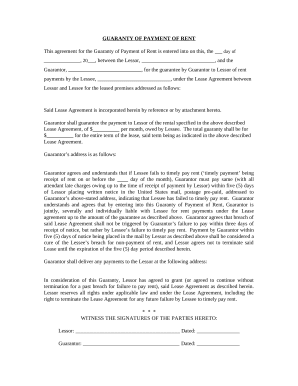
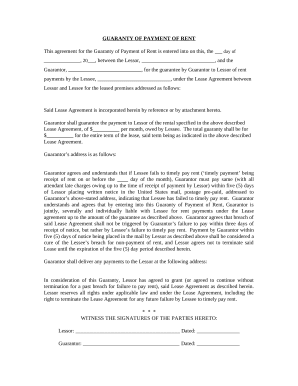
A lease guaranty is a contract between an individual or entity (guarantor) that is typically related to the tenant. The guarantor promises to pay the landlord any and all payments due under the lease in the event the tenant defaults under its lease obligations and otherwise cure the tenants defaults.
A personal guaranty is a separate legal document from the commercial lease. While the commercial lease is signed by the owner or an officer of the business on behalf of the corporation, a personal guarantee is signed by the business owner or owners personally.
In a lease context, a guaranty is the agreement by a party, not the tenant, to indepen- dently guarantee the complete performance of the tenants lease obligations. A guaranty typically is styled as a separate agreement between the landlord and the guarantor.
Minimum lease payments are rental payments over the lease term including the amount of any bargain purchase option, premium, and any guaranteed residual value, and excluding any rental relating to costs to be met by the lessor and any contingent rentals.
Corporate credit cards that are issued to an individual are another example of a personal guarantee. The individual or employee is responsible for the debt that the organization takes on and the overall spending on the credit card. Here, the cardholder takes the role of a guarantor.
How to get out of a personal guarantee on a commercial lease Subleasing the space to another tenant. Assigning the lease to another party. Use a break clause. Renegotiate the lease contract. Have a personal guarantee insurance. Breaking the lease.
A personal guarantee is a provision in your loan contract. When you agree to it, youre taking personal responsibility for the loan if the business defaults and cant repay it. In other words, if your business goes under or gets behind on loan payments, you are required to use personal assets to satisfy the debt.
Risk to Personal Assets The most direct risk of a personal guarantee is the potential loss of personal assets. This can include savings, real estate, vehicles, and even retirement accounts. In the event of a default, these assets could be seized by the lender to satisfy the debt.