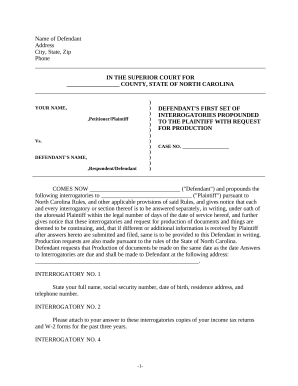
Enhance your form operations with Interrogatories from Defendant to Plaintiff

Your workflows always benefit when you can find all of the forms and documents you may need at your fingertips. DocHub supplies a a huge library of document templates to ease your everyday pains. Get hold of Interrogatories from Defendant to Plaintiff category and quickly find your form.

Begin working with Interrogatories from Defendant to Plaintiff in several clicks:

  1. Gain access to Interrogatories from Defendant to Plaintiff and get the form you need.
  2. Click on Get Form to open it in the editor.
  3. Begin adjusting your form: add more fillable fields, highlight paragraphs, or blackout sensitive details.
  4. The app saves your changes automatically, and once you are ready, you are able to download or distribute your file with other contributors.

Enjoy easy file managing with DocHub. Explore our Interrogatories from Defendant to Plaintiff collection and get your form today!


Video Guide on Interrogatories from Defendant to Plaintiff management

video background

Commonly Asked Questions about Interrogatories from Defendant to Plaintiff

Your answers to the interrogatories should usually be short, clear, and direct and should answer only the question that is being asked. This is not the time to set out your entire case or defense to the other side. Take the time to make sure your answers are correct and truthful.
You have to respond to interrogatories in writing to the best of your ability. If you do not answer an interrogatory question, and then the other side learns that you did in fact know the answer, it could have a negative impact on your case at trial.
Interrogatories are a collection of written questions you can send to the opposing party in a lawsuit. The other party must then respond in writing while under oath. The number of interrogatory questions you can send is typically limited to 30 to 45 at a time.
Use Form Interrogatories when you want to gather information from the other side by having them answer questions from a list on a form, and swear under oath that the answers are true.
After you complete your response, youll need to share your responses with the opposing side. You follow a specific court process to do this called serving papers.
Interrogatories are a discovery tool that the parties can use to have specific questions about a case answered before trial. Interrogatories are lists of questions sent to the other party that s/he must respond to in writing.
Interrogatories are a discovery tool that the parties can use to have specific questions about a case answered before trial. Interrogatories are lists of questions sent to the other party that s/he must respond to in writing. What are interrogatories and how are they used? - WomensLaw.org womenslaw.org laws trial what-are-inte womenslaw.org laws trial what-are-inte