
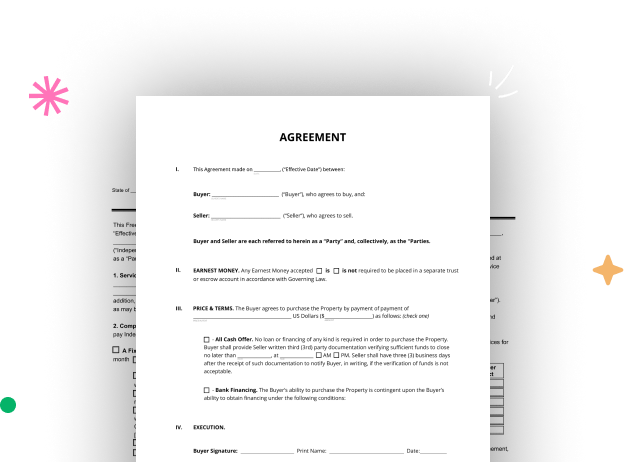



Create your Indiana Law Document from scratch

Start Building Now
Title decoration

Here's how it works

01. Start with a blank Indiana Law Document
Open the blank document in the editor, set the document view, and add extra pages if applicable.
02. Add and configure fillable fields
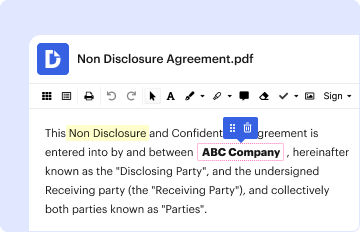
Use the top toolbar to insert fields like text and signature boxes, radio buttons, checkboxes, and more. Assign users to fields.
03. Distribute your form
Share your Indiana Law Document in seconds via email or a link. You can also download it, export it, or print it out.

A brief guide on how to build a polished Indiana Law Document

Form edit decoration

Step 1: Log in to DocHub to begin creating your Indiana Law Document.

First, sign in to your DocHub account. If you don't have one, you can simply sign up for free.

Step 2: Navigate to the dashboard.

Once logged in, go to your dashboard. This is your primary hub for all document-centric operations.

Step 3: Launch new document creation.

In your dashboard, select New Document in the upper left corner. Hit Create Blank Document to build the Indiana Law Document from a blank slate.

Step 4: Add template elements.

Place different fields like text boxes, images, signature fields, and other elements to your template and assign these fields to specific recipients as required.

Step 5: Configure your document.

Personalize your template by including walkthroughs or any other essential information using the text option.

Step 6: Review and correct the document.

Attentively go over your created Indiana Law Document for any mistakes or necessary adjustments. Leverage DocHub's editing tools to polish your document.

Step 7: Distribute or download the document.

After completing, save your file. You can opt to keep it within DocHub, transfer it to various storage platforms, or forward it via a link or email.


be ready to get more

Build your Indiana Law Document in minutes

Start creating now

Got questions?

We have answers to the most popular questions from our customers. If you can't find an answer to your question, please contact us.
Contact us
First, a representative sponsors a bill. The bill is then assigned to a committee for study. If released by the committee, the bill is put on a calendar to be voted on, debated or amended. If the bill passes by simple majority (218 of 435), the bill moves to the Senate. The Legislative Process | house.gov House.gov the-house-explained the-legisl House.gov the-house-explained the-legisl
Both the Senate and the House of Representatives must approve the bill before it can be sent to the governor for signature. The Governor Signs The Bill Into Law. House And The Senate Vote To Over-Ride The Veto. The Bill Becomes Law.
Citizen or group presents proposed law to mayor, council, commission, administrator, or staff person. Local lawmaking body discusses pros and cons of proposed law and makes changes. Staff person investigates need for proposed law. Lawyers review proposed law to see if it conflicts with existing laws.
If a bill has passed in both the U.S. House of Representatives and the U.S. Senate and has been approved by the President, or if a presidential veto has been overridden, the bill becomes a law and is enforced by the government. Grade School - How a Bill Becomes a Law - Kids in the House House.gov grade-school lesson House.gov grade-school lesson
How a Bill Becomes a Law STEP 1: The Creation of a Bill. Members of the House or Senate draft, sponsor and introduce bills for consideration by Congress. STEP 2: Committee Action. STEP 3: Floor Action. STEP 4: Vote. STEP 5: Conference Committees. STEP 6: Presidential Action. STEP 7: The Creation of a Law.
be ready to get more

Build your Indiana Law Document in minutes

Start creating now

Related Q&A to Indiana Law Document

An amendment is a formal or official change made to a law, contract, constitution, or other legal document. It is based on the verb to amend, which means to change for better. Amendments can add, remove, or update parts of these agreements.

Additional resources on building your forms