


Create your Homeowners Legal Form from scratch

Start Building Now
Title decoration

Here's how it works

01. Start with a blank Homeowners Legal Form
Open the blank document in the editor, set the document view, and add extra pages if applicable.
02. Add and configure fillable fields
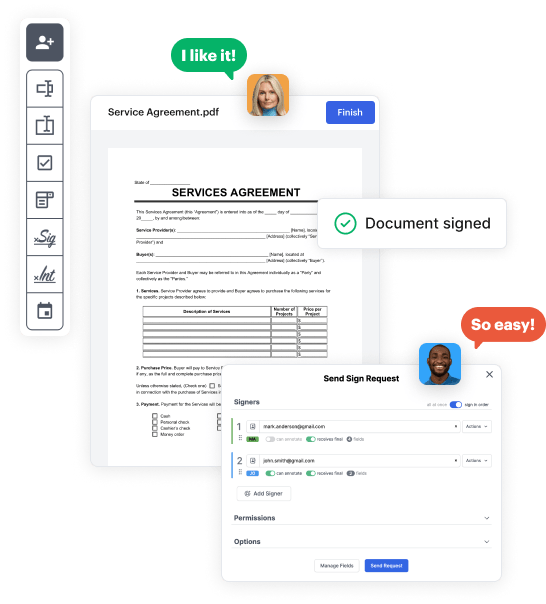
Use the top toolbar to insert fields like text and signature boxes, radio buttons, checkboxes, and more. Assign users to fields.
03. Distribute your form
Share your Homeowners Legal Form in seconds via email or a link. You can also download it, export it, or print it out.

A detailed guide on how to build your Homeowners Legal Form online

Form edit decoration

Step 1: Start with DocHub's free trial.

Visit the DocHub website and register for the free trial. This provides access to every feature you’ll need to create your Homeowners Legal Form with no upfront cost.

Step 2: Access your dashboard.

Log in to your DocHub account and go to the dashboard.

Step 3: Craft a new document.

Hit New Document in your dashboard, and choose Create Blank Document to craft your Homeowners Legal Form from the ground up.

Step 4: Use editing tools.

Insert different fields such as text boxes, radio buttons, icons, signatures, etc. Organize these fields to suit the layout of your document and designate them to recipients if needed.

Step 5: Modify the form layout.

Rearrange your document in seconds by adding, repositioning, deleting, or merging pages with just a few clicks.

Step 6: Create the Homeowners Legal Form template.

Transform your newly designed form into a template if you need to send multiple copies of the same document repeatedly.

Step 7: Save, export, or share the form.

Send the form via email, share a public link, or even publish it online if you want to collect responses from more recipients.


be ready to get more

Build your Homeowners Legal Form in minutes

Start creating now

Got questions?

We have answers to the most popular questions from our customers. If you can't find an answer to your question, please contact us.
Contact us
If you fail to pay your HOA or COA assessments in Oklahoma, the association can likely get a lien on your property and might foreclose on your home.
Unlike HOAs, POA real estate is not confined to homes. This type of association is more expansive in nature and can encompass both HOAs and COAs. POAs often govern over a mixture of residential properties and businesses. And so, a POA can span several neighborhoods, an entire town, or even several towns.
The Oklahoma Unit Ownership Estate Act governs the establishment, operation, authority, and management of condominium associations in the state. It covers the use of common elements, the necessary contents of COA bylaws, insurance requirements, and special assessments.
The Oklahoma Real Estate Commission (OREC) maintains multiple forms which real estate buyers, sellers, agents, and brokers can use to handle real estate transactions and leases. Each year, OREC makes a few changes to update forms as needed.
Parties are not required to use the OREC form contracts for their residential property sales in Oklahoma. Buyers and sellers are allowed to use their own custom agreements and frequently do so in for sale by owner contracts.
be ready to get more

Build your Homeowners Legal Form in minutes

Start creating now

Related Q&A to Homeowners Legal Form

Creating an HOA An HOA in Oklahoma is typically established as a non-profit corporation to manage a real estate development. The process begins with the filing of a certificate of incorporation under Oklahomas Title 60 Chapter 17, which outlines the general provisions for such entities.
The Oklahoma General Corporation Act governs HOAs that are incorporated as nonprofit corporations, as are the majority of Oklahoma HOAs.

Additional resources on building your forms