Get and handle General Power of Attorney Revocation Forms online

Accelerate your form managing with our General Power of Attorney Revocation Forms library with ready-made document templates that meet your needs. Access the form template, change it, complete it, and share it with your contributors without breaking a sweat. Begin working more efficiently together with your documents.

The best way to manage our General Power of Attorney Revocation Forms:

  1. Open our General Power of Attorney Revocation Forms and look for the form you require.
  2. Preview your form to ensure it’s what you want, and click on Get Form to begin working on it.
  3. Edit, include new text, or highlight important information with DocHub tools.
  4. Prepare your form and preserve the changes.
  5. Download or share your document template with other recipients.

Explore all of the possibilities for your online document administration with the General Power of Attorney Revocation Forms. Get a free free DocHub profile today!


Video Guide on General Power of Attorney Revocation Forms management

video background

Commonly Asked Questions about General Power of Attorney Revocation Forms

Revocation of power of attorney. (1) A principal may revoke a power of attorney by expressing the revocation in a subsequently executed power of attorney or other writing signed by the principal. The principal may give notice of the revocation to an agent who has accepted authority under the revoked power of attorney.
You may wish to revoke your power of attorney in the following circumstances: After your agent passes away. You no longer trust your agent. The individual can no longer act as your agent or does not want the responsibility.
If you decide that you no longer want or need a Power of Attorney, or if you change your mind about who your agent is, you can terminate a Power of Attorney by giving written notice to your agent. You should also give notice to your bank, your doctor, or anyone else who got a copy of your Power of Attorney.
A principal may revoke a power of attorney: (a) in ance with the terms of the power of attorney; or (b) by delivering a revocation of the power of attorney to the agent in person or by sending a signed and dated revocation by mail, courier, electronic transmission or facsimile to the agents last known address.
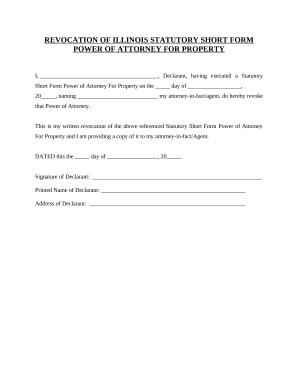
A Revocation of Power of Attorney must plainly state your desire to revoke a previous POA and include: The principals name. The attorney-in-facts name. The date the Power of Attorney took effect. The date the Power of Attorney is revoked. A notary public seal of certification (only required in certain states)
Revoking a durable power of attorney is an important legal matter, and it is advisable to seek professional legal counsel to ensure compliance with Florida laws. An attorney experienced in estate planning and elder law can provide personalized advice based on your specific situation.
Power of revocation refers to the ability to cancel or change a legal relationship that has been created. It is a type of authority that allows a person or organization to alter their rights, duties, liabilities, or other legal relations.