
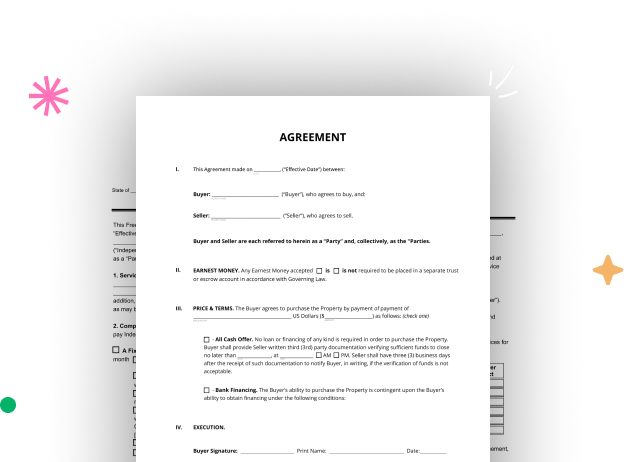
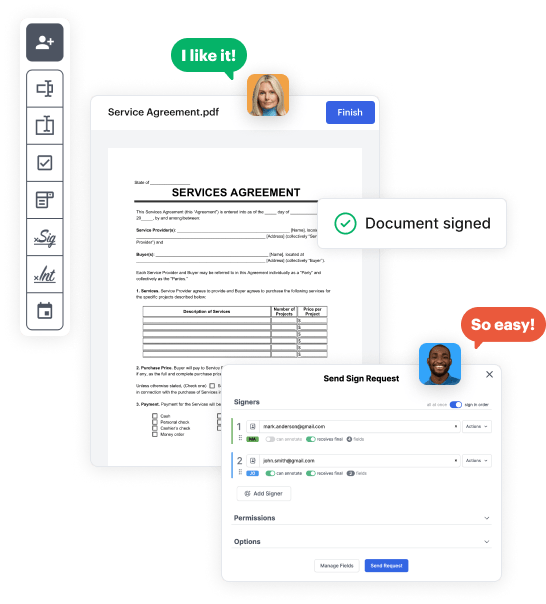
Create your Forestry Legal Form from scratch

Start Building Now
Title decoration

Here's how it works

01. Start with a blank Forestry Legal Form
Open the blank document in the editor, set the document view, and add extra pages if applicable.
02. Add and configure fillable fields
Use the top toolbar to insert fields like text and signature boxes, radio buttons, checkboxes, and more. Assign users to fields.
03. Distribute your form
Share your Forestry Legal Form in seconds via email or a link. You can also download it, export it, or print it out.

Create Forestry Legal Form from scratch with these step-by-step instructions

Form edit decoration

Step 1: Open DocHub and get going.

Start by setting up a free DocHub account using any offered sign-up method. If you already have one, simply log in.

Step 2: Sign up for a free 30-day trial.

Try out the complete suite of DocHub's advanced features by registering for a free 30-day trial of the Pro plan and proceed to build your Forestry Legal Form.

Step 3: Create a new blank form.

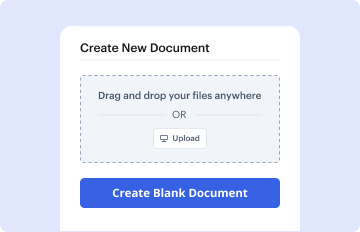
In your dashboard, choose the New Document button > scroll down and hit Create Blank Document. You’ll be redirected to the editor.

Step 4: Organize the document’s view.

Utilize the Page Controls icon marked by the arrow to switch between two page views and layouts for more convenience.

Step 5: Start adding fields to design the dynamic Forestry Legal Form.

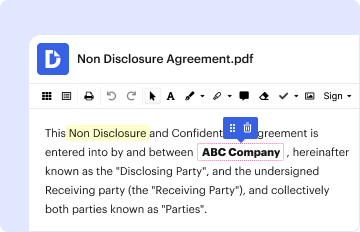
Navigate through the top toolbar to add document fields. Add and arrange text boxes, the signature block (if applicable), add photos, and other elements.

Step 6: Prepare and customize the added fields.

Configure the fillable areas you added based on your desired layout. Modify each field's size, font, and alignment to ensure the form is easy to use and professional.

Step 7: Finalize and share your form.

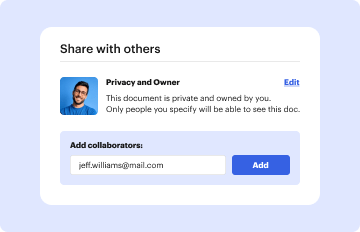
Save the ready-to-go copy in DocHub or in platforms like Google Drive or Dropbox, or craft a new Forestry Legal Form. Distribute your form via email or use a public link to engage with more people.


be ready to get more

Build your Forestry Legal Form in minutes

Start creating now

Got questions?

We have answers to the most popular questions from our customers. If you can't find an answer to your question, please contact us.
Contact us
The NRCS characterizes forest land use as land with at least 10 percent cover by trees that will be at least 13 feet (4 meters) tall at maturity. The land also shows evidence of natural tree regeneration.
The U.S.Forest Service was established in 1905 under the Transfer Act of February 1, 1905 (16 U.S.C. 472) which transferred the Federal forest reserves and the responsibility for their management from the Department of the Interior to the Department of Agriculture.
Forest Service Handbooks are the principal source of specialized guidance and instruction for carrying out the direction issued in the manual. Specialists and technicians are the primary audience of the handbook.
The difference between forests and woods comes down to canopy cover and tree density. While forests are known for thicker canopy cover (the amount of land covered by the tops of trees), woods usually have a more open canopy and sparser tree density, keeping the soil drier and unshaded.
The FOREST Act is critical to tackling global deforestation, nature loss, international crime, and climate change. The bill would help companies and governments meet their deforestation-free commitments and promote good governance and transparent and accountable global supply chains.
be ready to get more

Build your Forestry Legal Form in minutes

Start creating now

Related Q&A to Forestry Legal Form

The term forest is widely used to describe any landscape with trees, but is more commonly associated with regions that receive adequate precipitation to support dense stands of trees. View a map of the forested land managed by the BLM in the lower 48 states.
In a forest, 60% to 100% of the land is covered by tree canopy, while only 25% to 60% of a wood is covered by tree canopy. The United Nations Food and Agriculture Organization(Opens in a new window) defines the terms as well. ing to that agency, a forest must be at least 1.24 acres.
FIA defines forest land as land that has at least 10-percent canopy cover with trees of any size or formerly having had such tree cover and not currently developed for nonforest use. Generally, the minimum area for classification as a forest is at least 1 acre in size and 120 feet in width.

Additional resources on building your forms


