
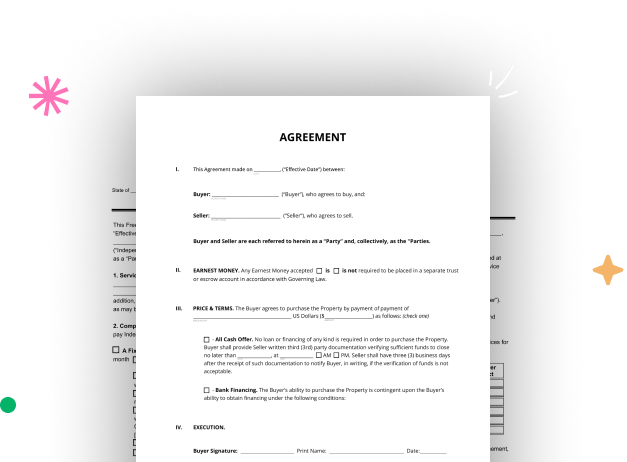
Create your Florida Legal Document from scratch

Start Building Now
Title decoration

Here's how it works

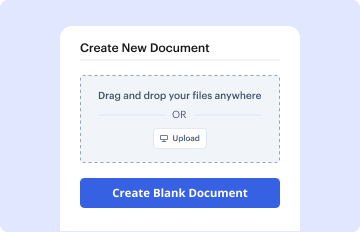
01. Start with a blank Florida Legal Document
Open the blank document in the editor, set the document view, and add extra pages if applicable.
02. Add and configure fillable fields
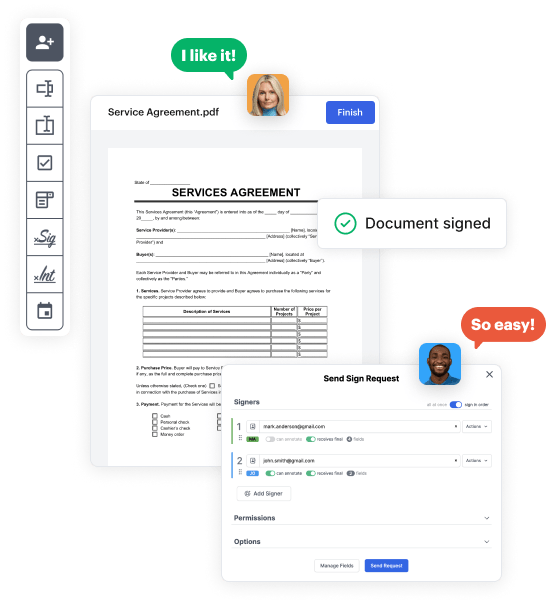
Use the top toolbar to insert fields like text and signature boxes, radio buttons, checkboxes, and more. Assign users to fields.
03. Distribute your form
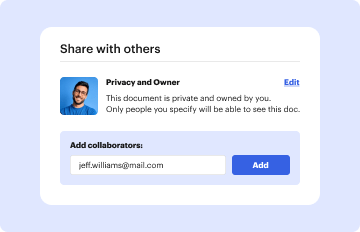
Share your Florida Legal Document in seconds via email or a link. You can also download it, export it, or print it out.

A simple tutorial on how to build a professional-looking Florida Legal Document

Form edit decoration

Step 1: Sign in to DocHub to create your Florida Legal Document.

First, sign in to your DocHub account. If you don't have one, you can simply register for free.

Step 2: Head to the dashboard.

Once logged in, head to your dashboard. This is your primary hub for all document-focused tasks.

Step 3: Kick off new document creation.

In your dashboard, hit New Document in the upper left corner. Choose Create Blank Document to design the Florida Legal Document from a blank slate.

Step 4: Insert template elements.

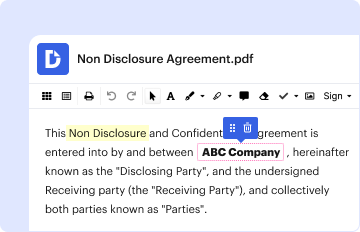
Place numerous fields like text boxes, photos, signature fields, and other options to your template and assign these fields to specific recipients as required.

Step 5: Fine-tune your template.

Customize your template by including directions or any other essential details leveraging the text tool.

Step 6: Double-check and adjust the form.

Carefully review your created Florida Legal Document for any discrepancies or essential adjustments. Utilize DocHub's editing features to perfect your template.

Step 7: Distribute or download the template.

After completing, save your copy. You may choose to save it within DocHub, export it to various storage services, or send it via a link or email.


be ready to get more

Build your Florida Legal Document in minutes

Start creating now

Got questions?

We have answers to the most popular questions from our customers. If you can't find an answer to your question, please contact us.
Contact us
How to File for Custody in Florida Parenting Plan (Form 12.995(a)) For general cases. Supervised/Safety-Focused Parenting Plan (Form 12.995(b)) For cases involving supervised custody. Relocation/Long Distance Parenting Plan (Form 12.995(c)) For cases involving the relocation of one or more parents.
Petitions usually cost $300 to $500 each.
See Florida Statute 61.13. Florida custody law does not give any preference to mothers or fathers when deciding child custody matters. Instead, the custody arrangement will depend on the specific facts and circumstances of each case. An attorney is not required in Florida child custody cases but can be very helpful.
The order to take into custody shall: (1) be in writing and signed; (2) specify the name, address, and sex of the child or, if unknown, designate the child by any name or description by which he or she can be identified with reasonable certainty; (3) specify that the child is of an age subject to the jurisdiction of
As of July 1st, 2023, there is a rebuttable presumption under Florida law that says equal timesharing is in the childs best interest, which means that a parent who wishes to pursue full custody has to legally prove by a preponderance of the evidence that equal timesharing is not in the best interest of the child and
be ready to get more

Build your Florida Legal Document in minutes

Start creating now

Related Q&A to Florida Legal Document

Important points to include in a legal document. Party details. List the names, numbers, addresses (email or physical), and any other relevant information of all parties involved. Background information. Motion. Roles and responsibilities. BdocHubes or contingencies. Dates and signatures.
Education and Registration High school diploma or equivalent and two years of experience under a licensed attorney. Any bachelors degree and one year of experience under a licensed attorney. ABA-approved legal document preparer program. Completed twenty-four college credits through an accredited program.
Under Florida service of process rules, only an authorized officer (usually the county sheriff) or a competent, disinterested third party appointed by the court can serve as a process server in civil cases.

Additional resources on building your forms