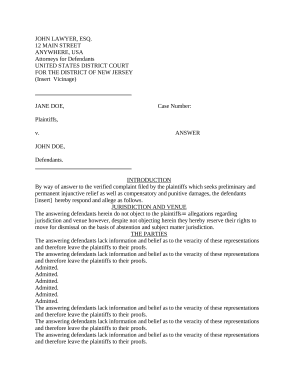
Improve your template administration with Federal Court Procedures

Your workflows always benefit when you are able to locate all the forms and files you may need on hand. DocHub offers a wide array of form templates to ease your daily pains. Get hold of Federal Court Procedures category and quickly find your document.

Start working with Federal Court Procedures in a few clicks:

  1. Access Federal Court Procedures and find the form you require.
  2. Click on Get Form to open it in the editor.
  3. Begin changing your document: add more fillable fields, highlight sentences, or blackout sensitive facts.
  4. The application saves your modifications automatically, and once you are all set, you can download or share your form with other contributors.

Enjoy easy file management with DocHub. Check out our Federal Court Procedures category and look for your form right now!


Video Guide on Federal Court Procedures management

video background

Commonly Asked Questions about Federal Court Procedures

The trial is a structured process where the facts of a case are presented to a jury, and they decide if the defendant is guilty or not guilty of the charge offered. During trial, the prosecutor uses witnesses and evidence to prove to the jury that the defendant committed the crime(s).
Federal courts enjoy the sole power to interpret the law, determine the constitutionality of the law, and apply it to individual cases.
The Federal Rules of Civil Procedure govern civil proceedings in the United States district courts. The purpose of the Federal Rules of Civil Procedure is to secure the just, speedy, and inexpensive determination of every action and proceeding. Fed. R. Civ.
Within the federal system, there are three primary types of federal courts: 94 District Courts (trial courts), 13 Courts of Appeals (intermediate appellate courts), and the United States Supreme Court (the court of final review).
Jurisdiction refers to the types of cases a court may hear. State courts have general jurisdiction, meaning they have authority over all kinds of cases. Federal courts have limited jurisdiction and only hear matters involving federal questions and constitutional matters. State courts have jurisdiction over state laws.
Federal courts have jurisdiction over cases involving: the United States government, the Constitution or federal laws, or. controversies between states or between the U.S. government and foreign governments.
Federal courts are courts of limited jurisdiction, meaning they can only hear cases authorized by the United States Constitution or federal statutes. The federal district court is the starting point for any case arising under federal statutes, the Constitution, or treaties.
MENU Steps in the Federal Criminal Process Investigation. Charging. Initial Hearing / Arraignment. Discovery. Plea Bargaining. Preliminary Hearing. Pre-Trial Motions. Trial.