
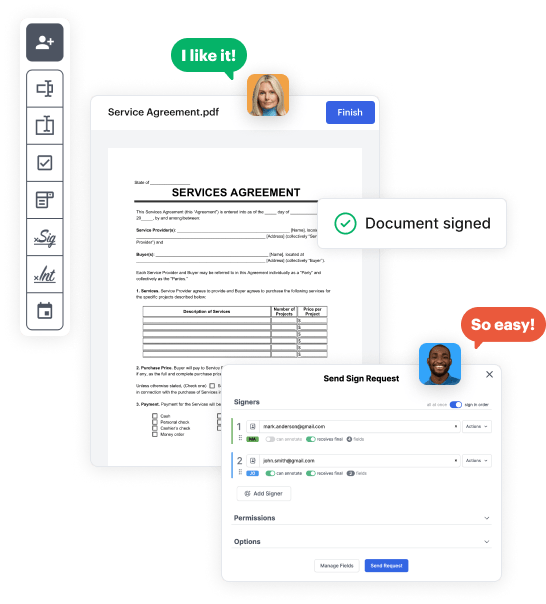
Create your Family Law Judgment from scratch

Start Building Now
Title decoration

Here's how it works

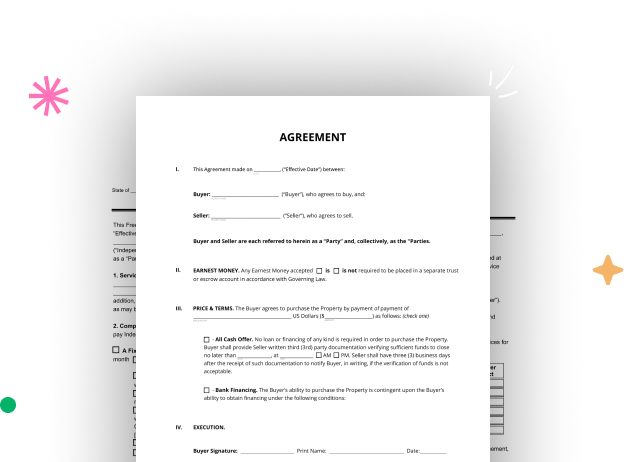
01. Start with a blank Family Law Judgment
Open the blank document in the editor, set the document view, and add extra pages if applicable.
02. Add and configure fillable fields
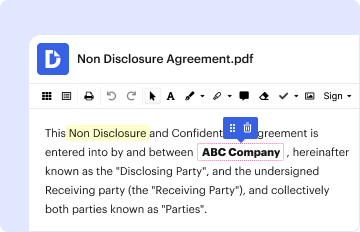
Use the top toolbar to insert fields like text and signature boxes, radio buttons, checkboxes, and more. Assign users to fields.
03. Distribute your form
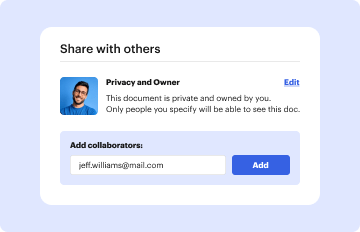
Share your Family Law Judgment in seconds via email or a link. You can also download it, export it, or print it out.

A brief guide on how to set up a polished Family Law Judgment

Form edit decoration

Step 1: Sign in to DocHub to begin creating your Family Law Judgment.

First, log in to your DocHub account. If you don't have one, you can easily sign up for free.

Step 2: Navigate to the dashboard.

Once signed in, access your dashboard. This is your primary hub for all document-based tasks.

Step 3: Initiate new document creation.

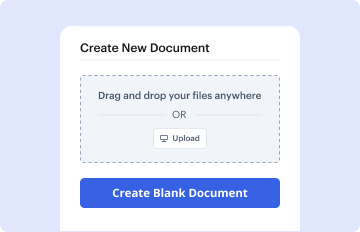
In your dashboard, hit New Document in the upper left corner. Hit Create Blank Document to put together the Family Law Judgment from a blank slate.

Step 4: Add template fillable areas.

Add different fields like text boxes, images, signature fields, and other interactive areas to your template and designate these fields to intended individuals as necessary.

Step 5: Configure your form.

Personalize your form by inserting guidelines or any other crucial details leveraging the text tool.

Step 6: Review and correct the document.

Carefully review your created Family Law Judgment for any mistakes or necessary adjustments. Make use of DocHub's editing capabilities to perfect your form.

Step 7: Share or export the form.

After finalizing, save your work. You may choose to retain it within DocHub, transfer it to various storage platforms, or send it via a link or email.


be ready to get more

Build your Family Law Judgment in minutes

Start creating now

Got questions?

We have answers to the most popular questions from our customers. If you can't find an answer to your question, please contact us.
Contact us
Reasons for change could include a feeling that the judge is biased or doesnt like you. The judge could even have some connection to the other party.
0:00 9:34 Hi thanks for using my court coach im sarah and ill be your instructor today as we talk about theMoreHi thanks for using my court coach im sarah and ill be your instructor today as we talk about the judgment form also known as form fl180. As with all our court forms you want to fill in your
To request a new judge in a family law child custody case in California, you can file a Peremptory Challenge under California Code of Civil Procedure Section 170.6. This allows you to disqualify the judge from hearing your case without having to provide a specific reason.
The general rule is that one trial judge may not modify or overrule an order entered by another trial judge on a matter of law. If the order is about a matter of discretion rather than a matter of law, the second judge may modify it, but only if there has been a substantial change in circumstances.
To raise a challenge, file an Affidavit of Prejudice Peremptory Challenge to Judicial Officer (form LACIV 015). A copy is available at . If you choose to draft your own affidavit, it must include specific language listed in the code cited above.
be ready to get more

Build your Family Law Judgment in minutes

Start creating now

Related Q&A to Family Law Judgment

A motion to recuse a judge can be filed by the prosecutor, the defense attorney, or the plaintiff or defendant in either a criminal or civil case. If you want to disqualify a judge, you must file a motion that includes specific language listed in the law at CCP 170.6. 4. This motion must be filed on time.

Additional resources on building your forms


