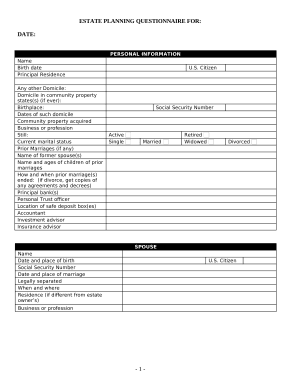
Supercharge your productiveness with Estate Planning Worksheets

Papers administration occupies to half of your office hours. With DocHub, you can easily reclaim your time and increase your team's efficiency. Access Estate Planning Worksheets category and explore all form templates relevant to your daily workflows.

Effortlessly use Estate Planning Worksheets:

  1. Open Estate Planning Worksheets and apply Preview to obtain the suitable form.
  2. Click on Get Form to begin working on it.
  3. Wait for your form to open in the online editor and start modifying it.
  4. Add new fillable fields, icons, and images, modify pages, etc.
  5. Fill your template or set it for other contributors.
  6. Download or share the form by link, email attachment, or invite.

Boost your daily file administration with the Estate Planning Worksheets. Get your free DocHub profile today to discover all templates.


Video Guide on Estate Planning Worksheets management

video background

Commonly Asked Questions about Estate Planning Worksheets

Tax Advantage: The 5 by 5 Power in a Trust is an effective method used to reduce estate taxes. It allows the Beneficiary to withdraw funds that are considered part of their taxable income, and not the Trusts. Thanks to this, it helps to preserve the trusts tax-advantaged status.
The 5x5 Power rule is a way to provide some parameters around the access a beneficiary has to the funds in a trust. It means that in each calendar year, they have access to $5,000 or 5% of the trust assets, whichevers greater. This is in addition to the regular income payout benefit of the trust.
A 5 by 5 Power in Trust is a clause that lets the beneficiary make withdrawals from the trust on a yearly basis. The beneficiary can cash out $5,000 or 5% of the trusts fair market value each year, whichever is a higher amount.
Key Takeaways Common estate planning documents are wills, trusts, powers of attorney, and living wills.
The five or five power is the power of the beneficiary of a trust to withdraw annually $5,000 or five percent of the assets of the trust.
Get a head-start on planning and follow these 7 easy steps: Take Inventory of Your Estate. First, narrow down what belongs to you. Set a Will in Place. Form a Trust. Consider Your Healthcare Options. Opt for Life Insurance. Store All Important Documents in One Place. Hire an Attorney from Angermeier Rogers.
Protect and Maximize Your Estate for Your Heirs In conclusion, when creating your estate plan, its crucial to prioritize these three key objectives: naming a trusted individual to handle your affairs, ensuring your estate goes to who you want it to, and protecting and maximizing your estate for your heirs.
One of the biggest mistakes parents make when setting up a trust fund is choosing the wrong trustee to oversee and manage the trust. This crucial decision can open the door to potential theft, mismanagement of assets, and family conflict that derails your childs financial future.