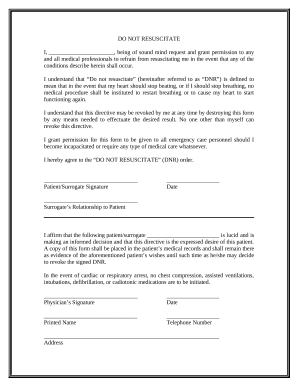
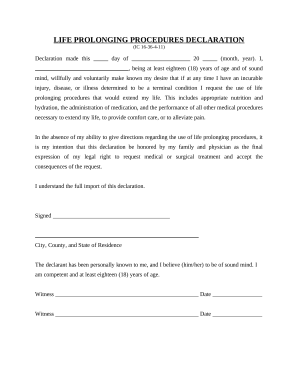
Enhance your efficiency with End-of-Life Decision Forms

Record management occupies to half of your office hours. With DocHub, you can reclaim your office time and increase your team's productivity. Get End-of-Life Decision Forms category and check out all form templates relevant to your day-to-day workflows.

The best way to use End-of-Life Decision Forms:

  1. Open End-of-Life Decision Forms and utilize Preview to obtain the appropriate form.
  2. Click on Get Form to start working on it.
  3. Wait for your form to open in our online editor and start modifying it.
  4. Add new fillable fields, icons, and pictures, modify pages, etc.
  5. Fill your file or set it for other contributors.
  6. Download or share the form by link, email attachment, or invite.

Boost your day-to-day file management with the End-of-Life Decision Forms. Get your free DocHub profile today to explore all forms.


Video Guide on End-of-Life Decision Forms management

video background

Commonly Asked Questions about End-of-Life Decision Forms

One is called a living will. The other is called an Advance Health-Care Directive.
A living will is one of the most common and necessary end-of-life documents. It is an advance directive that details your desires regarding medical treatment if you are no longer able to communicate your own wishes. A living will would spell out what medical care a person would or wouldnt want such as: Palliative care.
Types of Advance Directive There are two basic types: the living will and the durable power of attorney for healthcare.
The two most common advance directives for health care are the living will and the durable power of attorney for health care.
There are 2 basic components of an advance directive document: Living Will: your personal values and what would be most important to you at the end of life. Durable Power of Attorney: selecting your health care decision maker(s)
Common documents include a will, durable power of attorney for finances, and a living trust. Share this infographic to spread the word about getting your affairs in order. A will specifies how your estate your property, money, and other assets will be distributed and managed when you die.
The two most common forms of advance directives are Living Will and Durable Power of Attorney for Health Care.
Patients who are faced with a terminal illness can create a living will, also known as a health care directive, that will outline all of their wishes regarding end-of-life care should they become unable to communicate on their own. End of Life Document Checklist: A Complete Guide for Families asbestos.com support end-of-life-docum asbestos.com support end-of-life-docum
Advance Health Care Directive Also called Living Will, Durable Power of Attorney for Healthcare. Each state has slightly different versions of the form, but a form from one state will be honored in another state. Hospitals and most doctors offices will provide you with the form upon request.