Create your Employment Legal Document from scratch

Start Building Now
Title decoration

Here's how it works

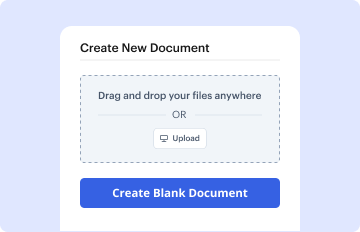
01. Start with a blank Employment Legal Document
Open the blank document in the editor, set the document view, and add extra pages if applicable.
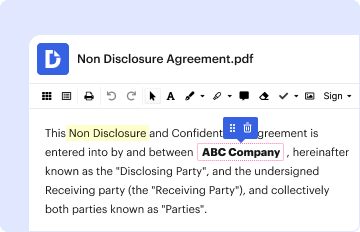
02. Add and configure fillable fields
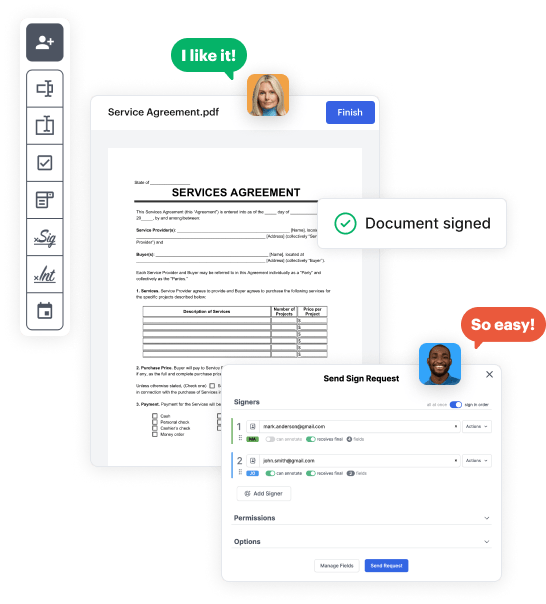
Use the top toolbar to insert fields like text and signature boxes, radio buttons, checkboxes, and more. Assign users to fields.
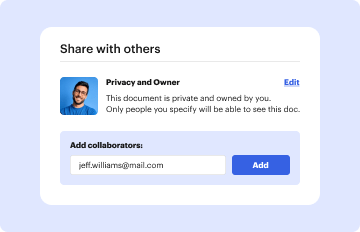
03. Distribute your form
Share your Employment Legal Document in seconds via email or a link. You can also download it, export it, or print it out.

A detailed walkthrough of how to design your Employment Legal Document online
Form edit decoration

Step 1: Start with DocHub's free trial.

Visit the DocHub website and sign up for the free trial. This provides access to every feature you’ll need to create your Employment Legal Document with no upfront cost.

Step 2: Access your dashboard.

Sign in to your DocHub account and go to the dashboard.

Step 3: Initiate a new document.

Click New Document in your dashboard, and select Create Blank Document to craft your Employment Legal Document from the ground up.

Step 4: Utilize editing tools.

Insert various fields such as text boxes, radio buttons, icons, signatures, etc. Organize these elements to suit the layout of your form and designate them to recipients if needed.

Step 5: Organize the form layout.

Organize your form easily by adding, moving, removing, or combining pages with just a few clicks.

Step 6: Craft the Employment Legal Document template.

Transform your freshly designed form into a template if you need to send many copies of the same document multiple times.

Step 7: Save, export, or share the form.

Send the form via email, share a public link, or even post it online if you want to collect responses from more recipients.

be ready to get more

Build your Employment Legal Document in minutes

Start creating now

Got questions?

We have answers to the most popular questions from our customers. If you can't find an answer to your question, please contact us.
Contact us
Guide to writing contracts of employment Names of the parties. The full details of the business, and the employees full name and address. Employment contract start date. Employees job title and description. Workplace. Working hours. Probationary period. Salary. Deductions.
When creating an Employment Contract, you can include the following terms: The type and rate of compensation. The frequency of payment. Vacation time. Specified work hours. Specified work location. Employee responsibilities. Length of a probationary period. Confidentiality, non-solicitation, or non-competition clauses.
Why You Need a Business Contract Lawyer. If youre asking whether you need a lawyer to draft a contract, legally, the answer is no. Anyone can draft a contract on their own and as long as the elements above are included and both parties are legally competent and consent to the agreement, it is generally lawful.
Generally, to be legally valid, most contracts must contain two elements: All parties must agree about an offer made by one party and accepted by the other. Something of value must be exchanged for something else of value. This can include goods, cash, services, or a pledge to exchange these items.
How to write a contract agreement in 7 steps. Determine the type of contract required. Confirm the necessary parties. Choose someone to draft the contract. Write the contract with the proper formatting. Review the written contract with a lawyer. Send the contract agreement for review or revisions.
be ready to get more

Build your Employment Legal Document in minutes

Start creating now

Related Q&A to Employment Legal Document

The agreement should be clear and concise, and it should cover all aspects of the teams work. The agreement should specify the teams goals, how team members will communicate with each other, what happens if someone violates the agreement, and so on.
The most common contract is a permanent contract, which means the term of work is indefinite. Employees on permanent contracts can be full-time or part-time and typically receive benefits.
What to Include in an employment contract An invitation to begin employment at your company. Job title and employment status. Job responsibilities and expectations (i.e. a job description) Start date. End date, if it is a fixed-term contract. Name of manager, supervisor or other reporting relationships. Work hours.

Additional resources on building your forms