
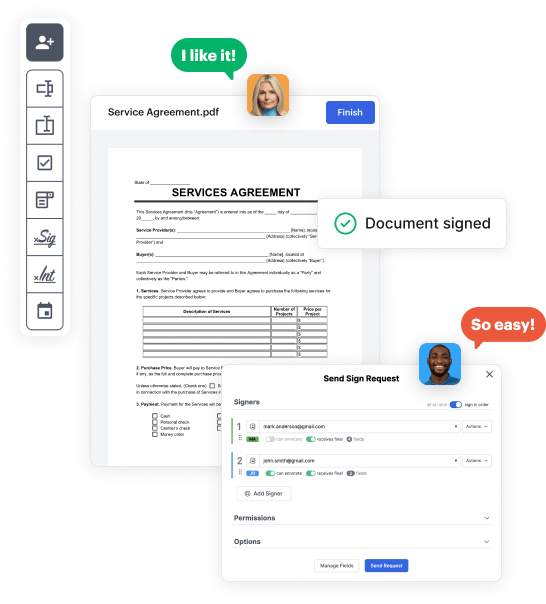
Create your Employment Legal Agreement from scratch

Start Building Now
Title decoration

Here's how it works

01. Start with a blank Employment Legal Agreement
Open the blank document in the editor, set the document view, and add extra pages if applicable.
02. Add and configure fillable fields
Use the top toolbar to insert fields like text and signature boxes, radio buttons, checkboxes, and more. Assign users to fields.
03. Distribute your form
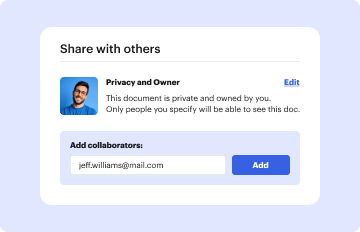
Share your Employment Legal Agreement in seconds via email or a link. You can also download it, export it, or print it out.

A brief tutorial on how to build a polished Employment Legal Agreement

Form edit decoration

Step 1: Sign in to DocHub to begin creating your Employment Legal Agreement.

First, log in to your DocHub account. If you don't have one, you can simply register for free.

Step 2: Head to the dashboard.

Once you’re in, go to your dashboard. This is your primary hub for all document-focused tasks.

Step 3: Start new document creation.

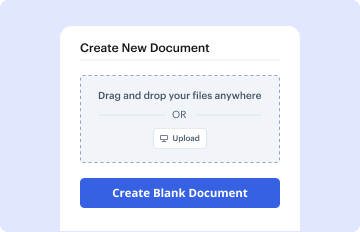
In your dashboard, click on New Document in the upper left corner. Choose Create Blank Document to design the Employment Legal Agreement from the ground up.

Step 4: Incorporate template elements.

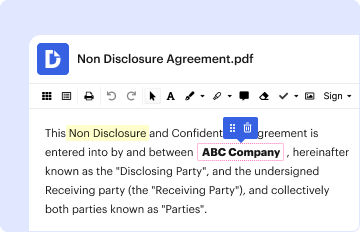
Place numerous fields like text boxes, images, signature fields, and other options to your template and assign these fields to particular users as needed.

Step 5: Adjust your document.

Refine your form by inserting instructions or any other essential details using the text option.

Step 6: Double-check and correct the form.

Attentively go over your created Employment Legal Agreement for any inaccuracies or needed adjustments. Leverage DocHub's editing tools to enhance your document.

Step 7: Distribute or download the document.

After completing, save your copy. You may select to save it within DocHub, transfer it to various storage services, or send it via a link or email.


be ready to get more

Build your Employment Legal Agreement in minutes

Start creating now

Got questions?

We have answers to the most popular questions from our customers. If you can't find an answer to your question, please contact us.
Contact us
An assignment of contract occurs when one party to an existing contract (the assignor) hands off the contracts obligations and benefits to another party (the assignee). Ideally, the assignor wants the assignee to step into their shoes and assume all of their contractual obligations and rights.
Yes, it is fairly common and you would also be OK under that clause as long as you do not solicit customers or employees of your prior employer.
An employment contract is an enforceable agreement between two parties that contains whatever terms and conditions of employment the parties agree upon and, when accepted, becomes controlling upon the employment relationship. The contract may be oral or written, express or implied (the latter terms are defined below).
When creating an Employment Contract, you can include the following terms: The type and rate of compensation. The frequency of payment. Vacation time. Specified work hours. Specified work location. Employee responsibilities. Length of a probationary period. Confidentiality, non-solicitation, or non-competition clauses.
During Employees employment, this Agreement may not be assigned by either party without the written consent of the other.
be ready to get more

Build your Employment Legal Agreement in minutes

Start creating now

Related Q&A to Employment Legal Agreement

Assignment. Employment agreements will also often contain an assignment provision to prohibit you from assigning your contract to someone else. This clause is included for your employers protection. Less often, a contract will contain language limiting your employers ability to assign your contract to another entity.
A contract may be unasdocHub if it requires performance from a specific individual or entity. For instance, if you have a contract with a celebrity to endorse your product, you cannot assign the contract to another celebrity unless the celebrity consents to the transfer.
Guide to writing contracts of employment Names of the parties. The full details of the business, and the employees full name and address. Employment contract start date. Employees job title and description. Workplace. Working hours. Probationary period. Salary. Deductions.

Additional resources on building your forms