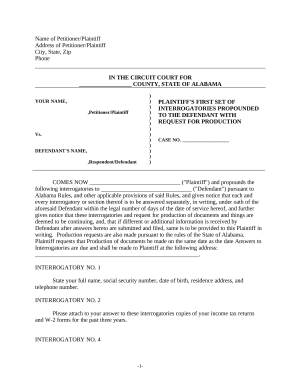
Get and handle Discovery Interrogatories online

Boost your form management with our Discovery Interrogatories library with ready-made form templates that suit your needs. Get your form, edit it, complete it, and share it with your contributors without breaking a sweat. Start working more effectively with the documents.

The best way to use our Discovery Interrogatories:

  1. Open our Discovery Interrogatories and look for the form you want.
  2. Preview your form to ensure it’s what you want, and click Get Form to begin working on it.
  3. Alter, include new text, or point out important information with DocHub tools.
  4. Complete your form and preserve the changes.
  5. Download or share your document template with other people.

Discover all the opportunities for your online document administration with the Discovery Interrogatories. Get your totally free DocHub account right now!


Commonly Asked Questions about Discovery Interrogatories

Read each question (interrogatory) very carefully. Answer only the question that is asked, and avoid the temptation to over-explain your answer. If the question contains several parts, you may break your answer into parts as well. It is also possible that you might object to the question. Respond to Special Interrogatories | California Courts | Self Help Guide ca.gov discovery-civil special-i ca.gov discovery-civil special-i
Disclosure is accomplished through a methodical process called discovery. Discovery takes three basic forms: written discovery, document production, and depositions.
Interrogatories are a discovery tool that the parties can use to have specific questions about a case answered before trial. Interrogatories are lists of questions sent to the other party that s/he must respond to in writing.
In civil procedure, an interrogatory is a list of written questions one party sends to another as part of the discovery process. The recipient must answer in writing under oath and ing to the cases schedule.
Interrogatories are written questions sent by one party in a lawsuit to another party in that same suit, which the responding party must answer under penalty of perjury. Interrogatories allow the parties to ask who, what, when, where and why questions, making them a good method for obtaining new information.
You have to respond to interrogatories in writing to the best of your ability. If you do not answer an interrogatory question, and then the other side learns that you did in fact know the answer, it could have a negative impact on your case at trial.
Read each question (interrogatory) very carefully. Answer only the question that is asked, and avoid the temptation to over-explain your answer. If the question contains several parts, you may break your answer into parts as well. It is also possible that you might object to the question.