



Create your Delaware Supreme Court Form from scratch

Start Building Now
Title decoration

Here's how it works

01. Start with a blank Delaware Supreme Court Form
Open the blank document in the editor, set the document view, and add extra pages if applicable.
02. Add and configure fillable fields
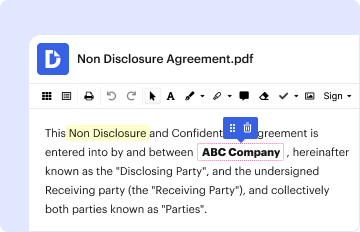
Use the top toolbar to insert fields like text and signature boxes, radio buttons, checkboxes, and more. Assign users to fields.
03. Distribute your form
Share your Delaware Supreme Court Form in seconds via email or a link. You can also download it, export it, or print it out.

Create Delaware Supreme Court Form from scratch by following these comprehensive instructions

Form edit decoration

Step 1: Start off by launching DocHub.

Start by setting up a free DocHub account using any offered sign-up method. Simply log in if you already have one.

Step 2: Register for a 30-day free trial.

Try out the complete collection of DocHub's advanced features by registering for a free 30-day trial of the Pro plan and proceed to craft your Delaware Supreme Court Form.

Step 3: Create a new blank form.

In your dashboard, click the New Document button > scroll down and hit Create Blank Document. You will be redirected to the editor.

Step 4: Arrange the view of the document.

Utilize the Page Controls icon marked by the arrow to switch between different page views and layouts for more flexibility.

Step 5: Begin by adding fields to design the dynamic Delaware Supreme Court Form.

Explore the top toolbar to place document fields. Add and format text boxes, the signature block (if applicable), insert images, etc.

Step 6: Prepare and customize the added fields.

Arrange the fillable areas you added per your preferred layout. Customize the size, font, and alignment to make sure the form is user-friendly and professional.

Step 7: Finalize and share your document.

Save the finalized copy in DocHub or in platforms like Google Drive or Dropbox, or craft a new Delaware Supreme Court Form. Distribute your form via email or get a public link to engage with more people.


be ready to get more

Build your Delaware Supreme Court Form in minutes

Start creating now

Got questions?

We have answers to the most popular questions from our customers. If you can't find an answer to your question, please contact us.
Contact us
Criminal Contempt. (a) Disposition After Notice. Any person who commits criminal contempt may be punished for that contempt after prosecution on notice. Rule 42. Criminal Contempt | 2024 Federal Rules of Criminal Procedure Federal Rules of Criminal Procedure title-viii Federal Rules of Criminal Procedure title-viii
Interest and Damages. 1. If a judgment for money in a civil case is affirmed, any interest allowed by law is payable from the date the judgment under review was entered. Rule 42. Interest and Damages | Supreme Court Rules | US Law Law.Cornell.Edu - Cornell University rules supct rule42 Law.Cornell.Edu - Cornell University rules supct rule42
Under Rule 42, the trial court must consider 1) whether, as a threshold matter, the order decided a substantial issue of material importance that merits appellate review before a final judgment, and 2) if so, whether a set of eight factors counsels for appeal.
The Court may order an action dismissed, sua sponte, upon notice of the Court, for failure of a party diligently to prosecute the action, for failure to comply with any rule, statute, or order of the Court, or for any other reason deemed by the Court to be appropriate. Rule 41 - Dismissal of actions, Del. R. Civ. P. Super. Ct. 41 - Casetext Casetext rule delaware-court-rules trials Casetext rule delaware-court-rules trials
Rule 29 - Dismissal (a)Voluntary dismissal. -At any time before filing of the appellees brief, an appellant may dismiss the appellants appeal voluntarily by serving a notice of dismissal upon the other parties to the appeal, by filing the same with the Clerk and paying the costs.
be ready to get more

Build your Delaware Supreme Court Form in minutes

Start creating now

Related Q&A to Delaware Supreme Court Form

When actions involving a common question of law or fact are pending before the court, it may order a joint hearing or trial of any or all the matters in issue in the actions; it may order all the actions consolidated; and it may make such orders concerning proceedings therein as may tend to avoid unnecessary costs or Rule 42-Consolidation; Separate Trials uscourts.gov frcpweb FRC00045 uscourts.gov frcpweb FRC00045
Rule 52. That the applicant is a person of good moral character and reputation and that the applicant possesses such qualities, aptitudes and disposition as fit the applicant for the practice of law.
Rule 25 - Substitution of parties (a) Death. (1) If a party dies and the claim is not thereby extinguished, the Court may order substitution of the proper parties.

Additional resources on building your forms


