Get and handle Default Legal Forms online

Speed up your document operations with our Default Legal Forms library with ready-made document templates that meet your needs. Access your document, edit it, fill it, and share it with your contributors without breaking a sweat. Start working more efficiently with your forms.

The best way to manage our Default Legal Forms:

  1. Open our Default Legal Forms and search for the form you want.
  2. Preview your document to ensure it’s what you want, and click Get Form to start working on it.
  3. Modify, add new text, or point out important information with DocHub features.
  4. Fill out your form and save the modifications.
  5. Download or share your form with other recipients.

Examine all of the possibilities for your online file management with our Default Legal Forms. Get a totally free DocHub profile right now!


Commonly Asked Questions about Default Legal Forms

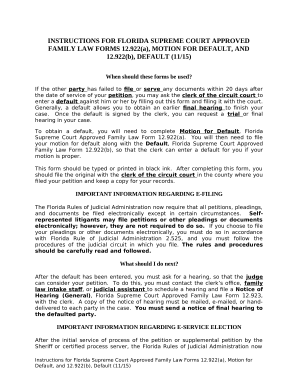
Once the clerk enters a default in the court record, the defendant is no longer able to file a response or otherwise participate in the case. The plaintiff can also request a judgment entered in his or her favor, at the same time as the default, or later. This is known as requesting a default judgment. Request a Default Judgment by Court Sacramento County Public Law Library resourcelibrary request-a-default-j Sacramento County Public Law Library resourcelibrary request-a-default-j
The Difference Between Default and Default Judgment Once in default, a party is no longer able to answer the complaint or otherwise respond to the complaint. The second step is asking for entry of a judgment that awards the relief sought in the complaint.
You must ask the clerk of the court to enter default against the defendant before you can move for default judgment. After the clerk enters default against a defendant and you move the court to grant a default judgment, you will have to argue that you should win your case as a matter of law. Guide: How to Request for Entry of Default - Federal Pro Se Clinic Federal Pro Se Clinic uploads 2024/01 Guide-H Federal Pro Se Clinic uploads 2024/01 Guide-H
In law, a default is the failure to do something required by law or to comply with a contractual obligation. Legal obligations can arise when a response or appearance is required in legal proceedings, after taking out a loan, or as agreed in a contract; failure to carry them out puts one in defaults of the obligations. Default (law) - Wikipedia Wikipedia wiki Default(law) Wikipedia wiki Default(law)
For example, lets say Annie files a lawsuit against Bridget. Bridget appears in court to argue her side of the case, but Annie forgets to go to court. The judge enters a default judgment against Annie and dismisses the lawsuit because Annie did not show up in court.
A default judgment (also known as judgment by default) is a ruling granted by a judge or court in favor of a plaintiff in the event that the defendant in a legal case fails to respond to a court summons or does not appear in court. default judgment | Wex | US Law | LII / Legal Information Institute Law.Cornell.Edu - Cornell University wex defaultjudgment Law.Cornell.Edu - Cornell University wex defaultjudgment
A notice of default is a statement sent by one contract party to notify another that the latter was in default by failing to fulfil the terms of an agreement and a legal action would follow if the latter continue to default. notice of default | Wex | US Law | LII / Legal Information Institute cornell.edu wex noticeofdefault cornell.edu wex noticeofdefault
A default occurs when a defendant/ respondent fails to answer the suit upon service within the time allowed by law. Summary judgment occurs upon motion of one of the parties to litigation that, upon the facts in evidence, the moving party is entitled to a judgment as a matter of law.
A default judgment (also known as judgment by default) is a ruling granted by a judge or court in favor of a plaintiff in the event that the defendant in a legal case fails to respond to a court summons or does not appear in court. default judgment | Wex | US Law | LII / Legal Information Institute cornell.edu wex defaultjudgment cornell.edu wex defaultjudgment
What Is Default Judgment? A default judgment occurs when the defendant in a legal case fails to respond to a court summons or does not appear in court. If this occurs, a court may rule in favor of the plaintiff by default.